New NAVAIR boss spells out vision, goals in visit to North Island depot
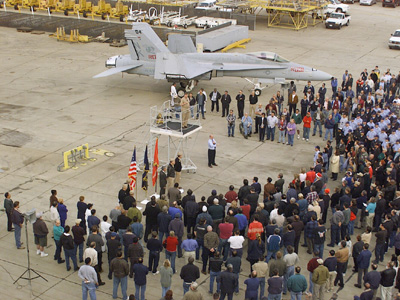
Commander Naval Air Systems Command Vice Adm. Wally Massenburg speaks to NAVAIR Depot North Island employees at Building 460 during his brief visit to the command late last month. Photo by Joe Feliciano
New NAVAIR boss spells out vision, goals in visit to North Island Depot
By Bill Bartkus
NAVAIR Depot North Island
CORONADO, Calif. – “If the Chief of Naval Operations stepped on an elevator with you and suddenly asked you what NAVAIR was all about, what would you tell him?” asked Commander Naval Air Systems Command Vice Adm. Wally Massenburg when he spoke to NAVAIR Depot North Island employees during his one-day visit to NAVAIR Depot North Island a week before Christmas.
The newly promoted three-star admiral, speaking to Depot employees, said that if the CNO asked him such a question, he would respond by saying, “NAVAIR provides cost-wise readiness and dominant maritime combat power to make a great Navy and Marine Corps Team better.”
He further stated that NAVAIR’s goals will be to balance current and future readiness, reduce the cost of doing business and improve our agility while we ensure alignment through implementation of fleet drive metrics.
Massenburg noted that NAVAIR’s vision and goals fit nicely with those he established for the depots in April 2003, namely “…to provide unsurpassed products to the fleet via a single organic capability while we increase reliability, decrease cycle time, reduce the cost of our products, strengthen commanding officer and executive officer authority and accountability, and improve material management.”
Massenburg told the crowd that one day after receiving his third star at a Pentagon promotion ceremony, he had a four-hour meeting with Chief of Naval Operations Adm. Vernon Clark and Vice Chief of Naval Operations Adm. Michael Mullen to discuss NAVAIR’s strategic plans. Massenburg said simply, “I explained our vision and goals.”
Massenburg commented that the NAVAIR depots are leading the way in cost-wise readiness and spoke of the progress made in adopting best practices to better support our fleet Sailors and Marines. “We are all on a journey that started with the depots in February (2003), and the change has been remarkable. Programs like Lean Manufacturing, Theories of Constraint, Six Sigma and others have changed the dimension of our workplace,” said Massenburg. “My intention is to bring that type of change to the rest of Naval Air Systems Command.”
He said that as NAVAIR he wants to dampen the historically large swings in resourcing priorities between current readiness and future investments. “I want the pendulum to produce a balance so that we pay for today’s readiness, and no more, while we intend to move tomorrow’s readiness through recapitalization. My goal is to produce a future where we properly support our Sailors and Marines,” he emphasized.
He again cited the depots for the positive efforts they have accomplished through AIRSpeed initiative. “We are decreasing cycle time, increasing reliability, and thereby decreasing the cost of naval aviation,” he said. “This is dramatic and wonderful.”
Highlighting the Depot’s importance to the fleet, Massenburg cited a study by a civilian company a year ago that revealed that Depot artisans are world-class and a cherished national asset. “Artisans produce readiness,” the admiral said. “But the study also revealed the need for better material management and senior Navy leadership acceptance of our organic Depot capability. My hope is that since last February you have seen that change,” he stated.
“Since last February, senior Navy leadership has been willing to value what you value and that is producing quality products that work for our Sailors and Marines. It’s not about us,” he reminded the crowd, “but about the 100,000 or so ‘kids’ who are deployed on the pointy edge of the spear. That’s what it’s all about.”
Massenburg went on to outline NAVAIR’s three-part vision and reiterated the need for all NAVAIR to immediately focus on delivering cost-wise readiness “because if we don’t, we will not be able to afford the recapitalization of our force for the future. This will leave the military of tomorrow with obsolete warfighting technology that will become increasingly more difficult and expensive to maintain,” he said. “Every person who is in a position to make decisions should continually work to drive cost out of our organization so we can afford our future.”
The second piece of the NAVAIR vision is to provide dominant maritime combat power. “If we’re going to send our forces to engage the enemy, we want to win. We want to be the best, and we don’t want an adversary that even comes close.”
Massenburg said that this was demonstrated in Afghanistan and in Iraq. “We continue to demonstrate it in the global war on terrorism as our machines (aircraft) go anywhere in the world to fight for freedom. It’s all about dominant maritime combat power,” he asserted.
Making the Navy and Marine Corps team better is the third and final piece of the NAVAIR vision. Massenburg said that the operational forces of the Navy and Marine Corps are wonderful machines that work hand in glove to accomplish a mission. He wants to continue and enhance that strong teaming relationship at NAVAIR.
“So the vision is that we produce cost-wise readiness and dominant maritime combat power to make a great Navy and Marine Corps team better,” said Massenburg. “Our vision is simple, focused, direct and that is what it’s going to be for the next three years. You can count on it!”
The new NAVAIR commander outlined his five goals essential to reaching the command’s vision.
“The first is to balance current and future readiness. We need to get today’s readiness right then drive out cost so that we can invest in tomorrow’s future,” he said. “If we don’t do this, we will not be properly supporting our Sailors and Marines who are out there (deployed).”
Massenburg’s second goal is to reduce cost. “We must do things less expensively with greater production,” he said. “Every person in the fleet needs to keep this thought in mind: to reduce costs today!”
Improving agility is the third goal. The admiral said that in the past when decisions were required, NAVAIR created groups and boards to create data and analyze issues. “We still couldn’t make decisions, so we created even more boards and groups until we were unable to react,” he said. “Improving agility means we will streamline the decision process and no longer rely on others to take control of our destiny.”
The next goal is enhancing alignment. The admiral made it clear when he said, “NAVAIR must be totally aligned with our own fleet in all that we do.” He pointed to the Air Boss (Commander Naval Air Forces) as the owner of Naval Aviation.
Fleet driven metrics is the final goal. The admiral related an experience he had while attending a recent conference. When he asked the group of engineers if they had a fleet driven metric, he was greeted with blank stares. He told them that if they didn’t have a single fleet driven metric that their jobs were irrelevant and they should be fired.
“Every person in NAVAIR can connect themselves to the fleet, but they need to take that journey. You (in the Depot) are lucky to have a direct connection. You are a fleet readiness center, Massenburg said. “Our challenge is for every member of NAVAIR to find that metric that connects them to the fleet.”
Massenburg wrapped up his remarks by challenging all to embrace his NAVAIR “elevator speech”.
“If the CNO asks you what NAVAIR is all about, you can say, ‘We produce cost-wise readiness and dominant maritime combat power to make a great Navy and Marine Corps team better. We are going to do this by balancing current and future readiness while we reduce cost.
“We are going to improve the agility of our decision making and we’re going to enhance alignment with our fleet by being driven by fleet metrics.’”