NAVAIR’s spirit of innovation captured in Discovery Science feature on ACETEF
By Amy Behrman
NAVAIR Network Centric Warfare Office
The story of NAVAIR’s commitment to warfare innovation and unique contributions to naval aviation mission success was brought to life last week for an international television audience.
The Air Combat Environment Test and Evaluation Facility (ACETEF) – a key node in NAVAIR’s integrated, distributed Research, Development, Test & Evaluation (RDT&E) environment – was chosen by Discovery Channel producers as one of a range of cutting-edge subjects and products to be featured on “Techknowledge” -- a 13-part series airing on Discovery’s Science Channel.
“Discovery was immediately hooked by ACETEF’s sophisticated modeling and simulation technologies…particularly how these unique capabilities are used to assess advanced technologies and their impact on warfighting,” said John Robusto, NAVAIR’s Director of Network Centric Warfare (AIR-4.0X), who was interviewed for the program.
“NAVAIR is leveraging a proven RDT&E capability to accelerate warfare innovation and develop tomorrow’s net-centric capabilities – through direct collaboration with our warfighters and industry partners,” Robusto added.
In the program, one of NAVAIR’s resident warfighters, Cmdr. Bill “Roto” Reuter, Chief Test Pilot for VX-23, leads viewers through a virtual tour of ACETEF’s Manned Flight Simulator, Anechoic Chamber, and Warfare Simulation Lab – to illustrate how each of the elements of a distributed warfare simulation environment interact to create an incredibly realistic combat environment.
Cmdr. Reuter related hands-on experience to explain how ACETEF labs and simulators enable pilots to push warfare systems to their limits and demonstrate boldly innovative tactics and techniques in a low-risk, high fidelity warfare environment.
Co-innovating with the Warfighter.
In the segment, Cmdr. Reuter is shown flying a simulated mission in the F/A-18 cockpit simulator at ACETEF’s Manned Flight Simulator, and later describes how the simulator “talks” to a real Super Hornet, hanging in an anechoic (no echo) chamber on base – a concept referred to as “hardware-in-the-loop”.
Climbing into the cockpit of a Super Hornet in the anechoic chamber, “Roto” then explains how simulated enemy signals generated in the Warfare Simulation Lab are ported into the aircraft’s mission computer, sensors and weapons systems.
“We’re tricking this airplane into thinking that it’s flying, so that it can perform in the actual combat scenario that we’ve got set up for it,” said Reuter during his interview. “All of that information is then being fed in to me in the simulator where I can then react to the threats fly essentially this aircraft even though it’s sitting perfectly still.”
The segment also highlighted NAVAIR’s role in developing advanced combat capabilities for future joint warfare missions.
“What we're going to do here [at NAVAIR] is place the warfighter on the forefront and allow them to drive the innovations, the inventions, or the capabilities they need to be effective in combat today and return safely home,” said Mr. Robusto in an interview with Discovery Science producers.
“It’s an amazingly effective tool for us to be agile in today’s environment,” said Cmdr. Reuter, adding that ACETEF allows Warfighters to “co-innovate” with NAVAIR engineers – increasing agility in the development, test and application of new technologies and warfighting innovations.
The application of modeling and simulation also makes good business sense.
“NAVAIR’s linked battlespace engineering complex enables us to quickly demonstrate future joint capabilities…with a level of analytical rigor equaled to the demands of live flight test…and then measure the relative contributions of various systems and warfare tactics to the combat equation,” said Robusto.
“Our goal is to speed the delivery of affordable and highly interoperable combat capabilities to the Warfighter," said Robusto. "Increasing the use of modeling and simulation simply makes good business sense for the naval aviation enterprise.”
Techknowledge airs Wednesday nights at 8:30 and 11:30 on the Science Channel. For more information on this segment, contact the NAVAIR NCW office at 301-757-2394.
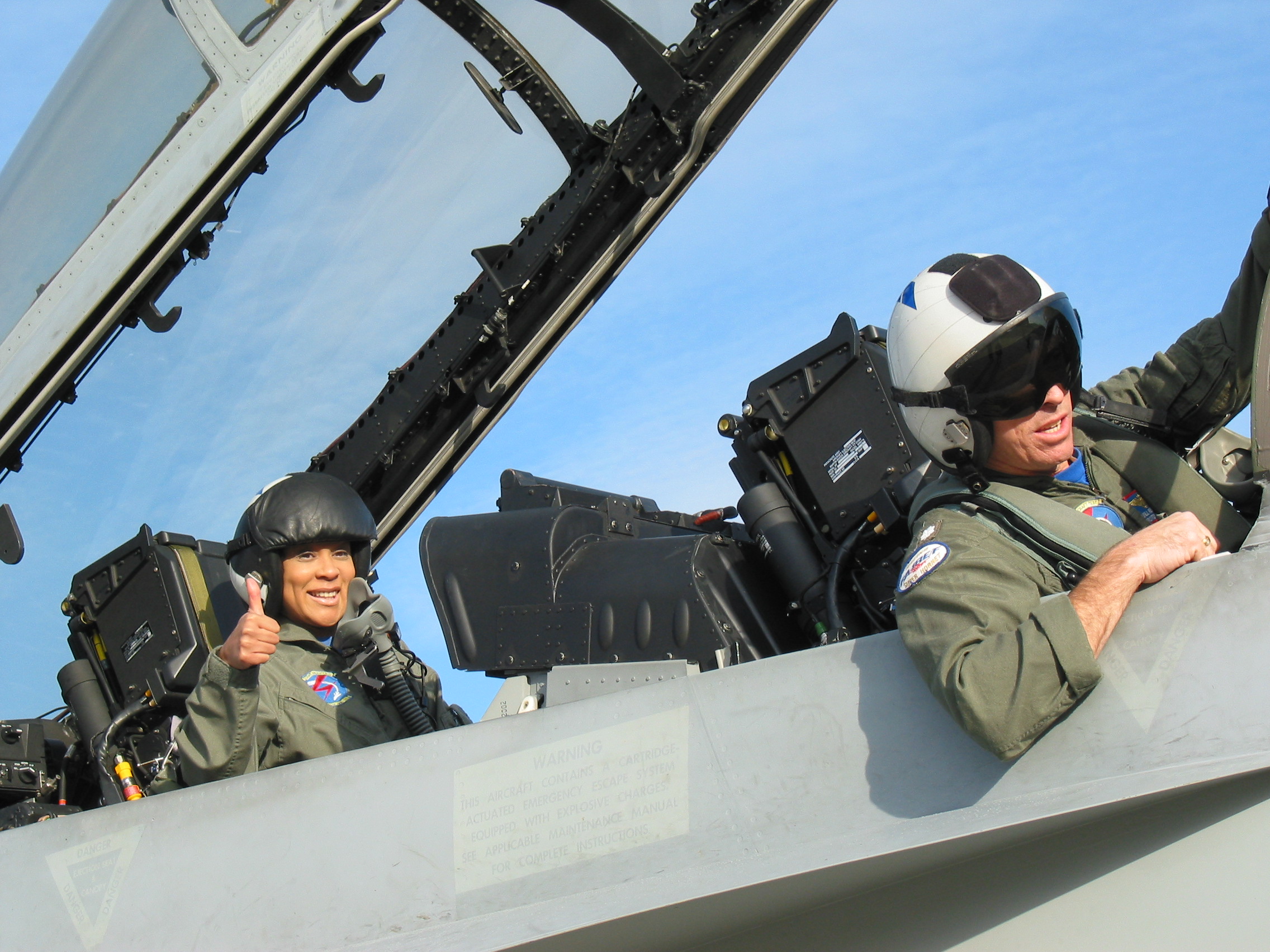
PHOTO CAPTION:
A view from the cockpit -- Cmdr. Bill “Roto” Reuter, Chief Test Pilot for VX-23, is pictured with “Techknowledge” host Tanya Hutchins. Cmdr. Reuter provided a series of interviews along with a brief taxi ride in an F/A-18E/F Super Hornet during taping for a Science Channel feature on NAVAIR’s Air Combat Environment Test and Evaluation Facility (ACETEF).