Hawkeye program rolls along at NAVAIR Depot North Island
Building 475 cuts
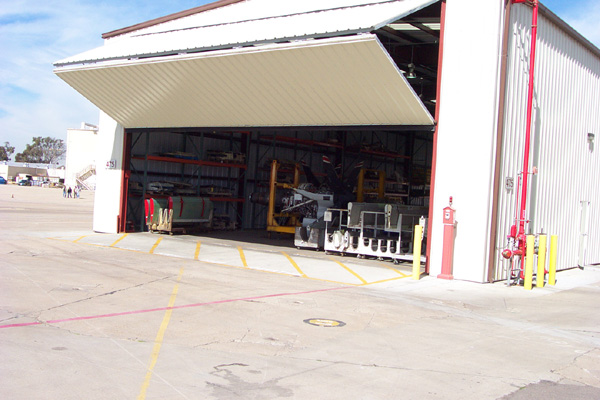
475
Building 475 was built specifically for E-2 modules.
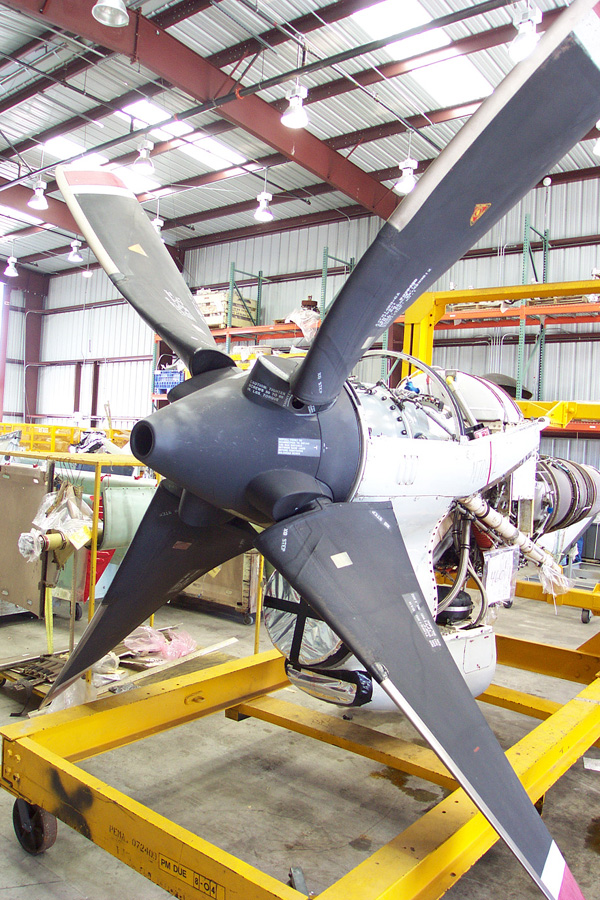
Engine
A T-56 engine sits in Building 475 waiting to the installed on an E-2.
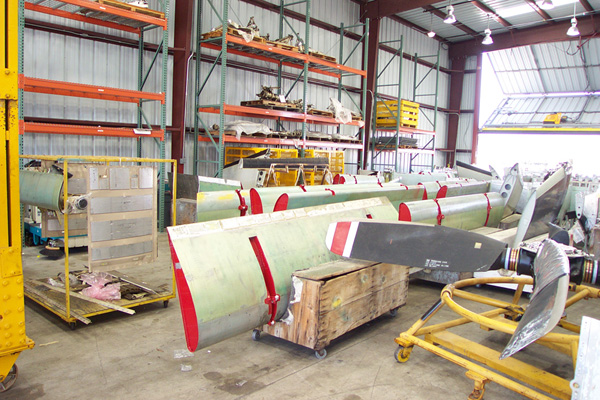
Storehouse
Aircraft parts in Building 475 await installation.
Hawkeye program rolls along at NAVAIR Depot North Island
Story, photos by Bill Bartkus
NAVAIR Depot North Island
CORONADO, Calif. – “Call it a precursor to AIRSpeed and Theory of Constraints if you will,” says Brian Delaney, “but having a building built specifically to store modules for the Hawkeye benefits the E-2 and C-2 Program and helps us to provide better service to the warfighter by reducing turnaround time.” Delaney, deputy program manager for the E-2 and C-2 Program at NAVAIR Depot North Island, was referring to a new building adjacent to the hangar where artisans work on the E-2 Hawkeye and the C-2A Greyhound here.
“Before we had Building 475, we had to store E-2 modules all over the Depot,” said David Lindsay.
“Having the modules stored next door helps us to get Hawkeyes back to the customer sooner.”
Lindsay said that tail modules, outer wing panels, and pylons – the three major components on the E-2, and engines are stored in the building. “We build these modules six months in advance of the aircraft coming to the Depot for the Integrated Maintenance Concept Program,” said Lindsay. “We need a place to store these modules and (Building) 475 was built specifically for this purpose.”
“Working on the modules gives the Depot a shorter turnaround time on the aircraft when we bring them in,” said Lorren Jensen. “This shortens the turnaround time on an E-2 Planned Maintenance Interval II aircraft.”
Delaney said that the turnaround time was reduced to 120 days from 210 days. “This is an impressive feat,” he said.
“Our job is to have all of the modules ready to install when the aircraft comes into the Depot,” said Jim Davis. “Then they are stored for ready installation after the metal phase.”
Delaney, Lindsay, Jensen and Davis comprise part of the E-2 Strategic Business Unit.
When the aircraft arrives, artisans replace the tail. “Before, we had to take all the components off the tail, then we had to route them out to the process shops,” said Lindsay. “We had to put the tail back together and put it back on the aircraft.” He said that the tail was the long pole in the tent and the hardest thing to get done in the program. “This took the longest lead time to get back to the aircraft, so we came up with the system of getting the module built ahead of time. We bring the airplane in, we take the tail off, we put a whole reworked tail on, and we’re ready to go!”
Lindsay said that the same procedure applies to the outer wing panels. “We pull the old ones off and put the new ones on,” he said.
“To me, this process was a precursor to AIRSpeed, and Theory of Constraints,” said Delaney. “It wasn’t when we started, but I guess you could say it is now.”
The modular system has been in place for seven years. “In the past, modules had to be stored in multiple locations because we didn’t have room in 460,” said Davis. “Now that we are where we want to be on the E-2C Program, we’re in the process of trying to set up modules for the C-2 aircraft.”
NAVAIR provides cost-wise readiness and dominant maritime combat power to make a great Navy and Marine Corps team better.