Getting SLEP'D at NAVAIR Depot North Island
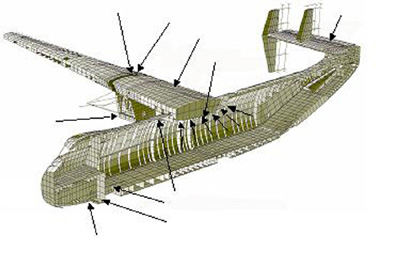
An Engineering computer model shows the areas of the C-2 SLEP enhancement.
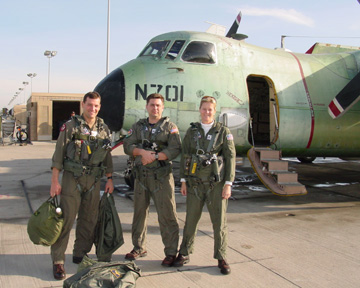
Copilot Lt. Keith Dienstl, AD1 Joe Patterson, crew chief, and Lt. Cmdr. Tiffany Lord, head Depot C-2 test pilot, before N701’s maiden voyage. Photo by Kevin Maguire
GETTING SLEP’D AT NAVAIR DEPOT NORTH ISLAND
By Mike Hammond
NAVAIR Depot North Island Public Affairs
It’s old. It’s beat up. It’s slow. It’s not cool in any way, shape or form. It’s also the most anticipated aircraft arrival on any of the most modern of the U.S. Navy’s aircraft carriers.
“It” is the venerable Grumman C-2A Greyhound aircraft, a veteran of nearly 40 years of flying people, parts and mail out to the carriers and their battle groups at sea. But the COD, for Carrier On-board Delivery, was getting tired, with only 35 of them left to serve America’s carrier fleet around the world, and no replacement in the acquisition pipeline. Though the original C-2A’s first flown in the mid-60’s had all been replaced by 1990, the ever-increasing tempo of the Navy’s operations has today’s Greyhounds near, and in some cases, beyond, their planned operating service life of 15,020 carrier landings and 10,000 flight hours. To keep the C-2A flying in its critical fleet-readiness logistics role, the Naval Air Systems Command (NAVAIR) Depot at North Island, San Diego, Calif., the Navy’s West Coast tactical aircraft maintenance and repair facility, initiated a Service Life Extension Program of skilled artisans, logisticians and engineers to validate, verify, prototype and field an extremely complex Airframe Change (AFC-171) with the necessary structural enhancements for safe and economical operation of the Greyhound fleet.
Fifteen months later, with numerous challenges overcome during a tight schedule, the NAVAIR SLEP Team saw its efforts rewarded when Bureau Number 162169 took to the air in a flight from NAS North Island piloted by the Depot’s Lt. Cmdr. Tiffany Lord. “She flies like a C-2 should,” said Lord after the flight, “lots of stick and rudder.”
The structural enhancements provided by the NAVAIR team at North Island, including coldworking thousands of fastener holes in the wing center section, fuselage keel, horizontal tail and engine nacelles, will allow the Greyhounds to operate now for up to 36,000 landings and 15,000 flight hours. All 35 remaining in the fleet will receive the SLEP upgrades within the next seven years, enabling combat commanders to conduct and sustain expeditionary carrier battle group operations with rapid, long range (up to 1000 nautical miles) high priority air logistics.
Scott Goldberg, who oversees for NAVAIR the C-2 efforts at North Island, has high praise for the SLEP group that brought the effort to fruition. “The team has done an incredible job designing and installing this very complex change. The benefits to the fleet are huge, since (SLEP) nearly doubles the C-2’s service life and meets the Chief of Naval Operations’ goal of keep the aiframe in service until 2015-2020.”
NAVAIR provides cost-wise readiness and dominant maritime combat power to make a great Navy and Marine Corps Team better.
- 30 –