
NAVRIIP leaders revisit the E-2C T/M/S to find successes
By Adolph A. Mitchell, Public Affairs Specialist, NAVAIR WD, Point Mugu
and NAVRIIP Communications Action Team
Leaders of the Naval Aviation Readiness Integrated Improvement Program (NAVRIIP) returned to Naval Base Ventura County (NBVC), Point Mugu, California in early December 2003 to observe improvements for the E-2C type-model-series (T/M/S) since their last visit in October 2002.
During the last visit, 102 barriers to E-2C readiness were identified across four systems – radar, indicated friend or foe (IFF), joint tactical information distribution system (JTIDS), and nose landing gear door (NLGD) assembly. Immediately, 20 barriers were resolved by the local Aircraft Intermediate Maintenance Detachment (AIMD) and subsequently, 50 others were resolved. The remaining barriers were either solved by the type commander (TYCOM), program managers and support staffs, or the return on investment was determined miniscule.
Since then, the support for each squadron has also increased due to the implementation of the “Relevant Information For Leadership” (RIFLe) philosophy. RIFLe incorporates the Theory of Constraints (TOC), and works to alleviate the impact of bottlenecks within the operations process. By horizontally integrating stovepipe logistics, RIFLe evaluates procedures at the operational level for improvements that will employ less effort, less resources, and increased effectiveness.
“The results have been outstanding,” said Cmdr. Carolynn Snyder, Point Mugu AIMD, officer-in-charge. “We have a 50 percent decrease in items waiting for repair, a 75 percent decrease in due in from maintenance items (DIFM) and our average customer wait time (ACWT) has decreased from eight days to one and a half days.”
“One of our major success stories is radar communication (RADCOM) availability,” said Snyder. “RADCOM was one of the first barrier removal teams (BRT) launched because it affected two other systems and only had an average of 30 percent availability. The BRT identified over 45 barriers and removed each one resulting in an increase to 95 percent availability. This increase allowed for overall radar ACWT to decrease by 15 days.”
Hosted by NBVC and Capt. Roger Jaskot, commander, Airborne Early Warning Wing, Pacific Fleet (COMAEWWINGPAC), the NAVRIIP leadership group, lead by VADM Wally Massenburg, commander, Naval Air Systems Command, toured the Point Mugu AIMD and Aircraft Supply Department (ASD) to meet with Navy and civilian personnel in the shop spaces. The leaders spoke with maintainers throughout the work spaces to collect feedback on readiness solutions implemented over the past year, and to learn of unique readiness improvements initiated. Since the last visit, no new barriers to readiness were identified. The Fleet maintainers have been using the process improvement tools to continually increase AIMD readiness rates by analyzing the current procedures to make necessary adjustments.
“One of these best things that NAVRIIP has done is get all of the players in the Naval Aviation Enterprise talking to each other and focused on the same issues,” said Snyder. “Rather than a number of disjointed and fragmented initiatives, there are now a smaller number of focused, resourced and researched efforts to tackle the T/M/S readiness issues.”
“Since the NAVRIIP visit a year ago, we gained insight on how to determine the appropriate number of trained manpower, and we learned how to locate the primary cost drivers that were preventing us from achieving our goal of getting the right quantity and quality of Fleet members we need at the operational level,” said Jaskot.
“The sea/shore rotation at Point Mugu is limited and it is sometimes difficult to get the people we need,” said Jaskot. “The squadron is trying to enhance opportunities for maintainers to rotate to Point Mugu as well as to ensure that they receive the proper training before their assignment begins. Ultimately, we’re trying to achieve the optimum number of aircraft ready for training and operations (A-RFTO). The NAVRIIP process has helped us to get closer to achieving the proper entitlement,” Jaskot continued.
A specific example of the NAVRIIP process is the recent resolution of the E-2C shipping barrier that was identified during the previous visit to Point Mugu. “In the past, the shipping process caused damage to the engines. We suffered financially as well as lost maintenance time,” said Jaskot. “We built a container which will be incorporated into the delivery system this year to prevent the engines from being damaged.”
“Engines have a direct effect on A-RFTO availability. By eliminating unnecessary workloads caused by damaged engines, we improved overall aircraft cost-wise readiness,” continued Jaskot.
Jaskot and other wing officers have shared cost-wise readiness initiatives and goals with their staffs. “We are aligning to the CNO’s construct to have the right amount of aircraft and the right amount of manpower for each specific task. We are utilizing the appropriate supplies and training for the mission,” concluded Jaskot.
Massenburg reiterated the importance of identifying cost drivers to increase current and future readiness. “NAVRIIP is a program designed to make fundamental process changes to the way the Navy provides manpower, equipment, maintenance, supply and training to stateside Naval Aviation commands between deployments,” said Massenburg. “NAVRIIP’s focus is expanded to expedite the development and implementation of cost-wise solutions to readiness barriers as Naval Aviation changes its processes.”
For more information on NAVRIIP, link to http://www.airpac.navy.mil/navriip/ or contact NAVAIR Public Affairs by calling 301-757-1487.
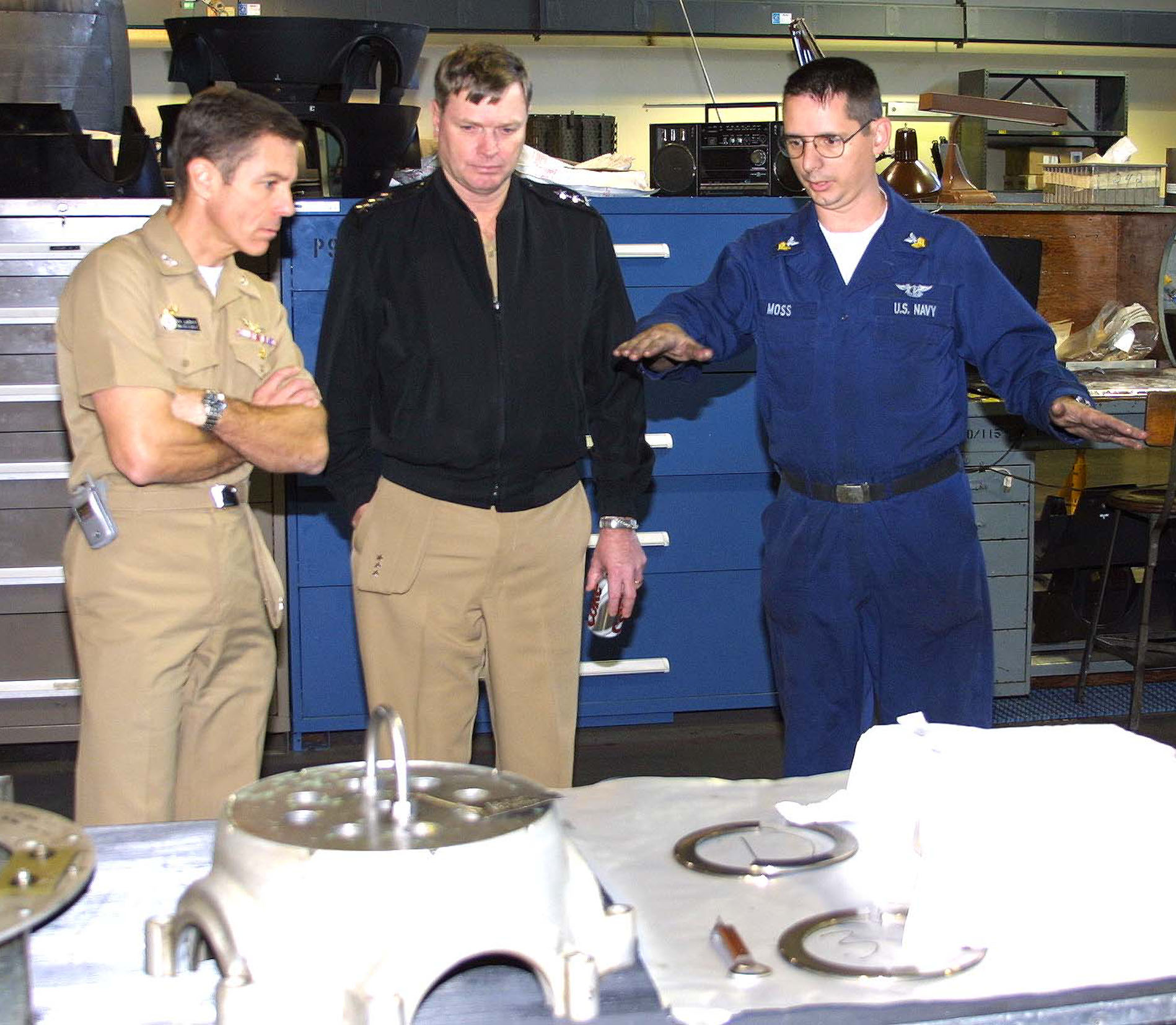
Photo Caption:
Aviation Machinist Mate Sean Moss, AIMD work center propeller shop supervisor, discusses a barrel assembly for a P3 prop and the associated thrust washers that were disassembled with VADM Massenburg and Capt. Steve Labelle during the NAVRIIP visit.
Photo by Adolph A. Mitchell