
New NAVAIR commander delivers his vision
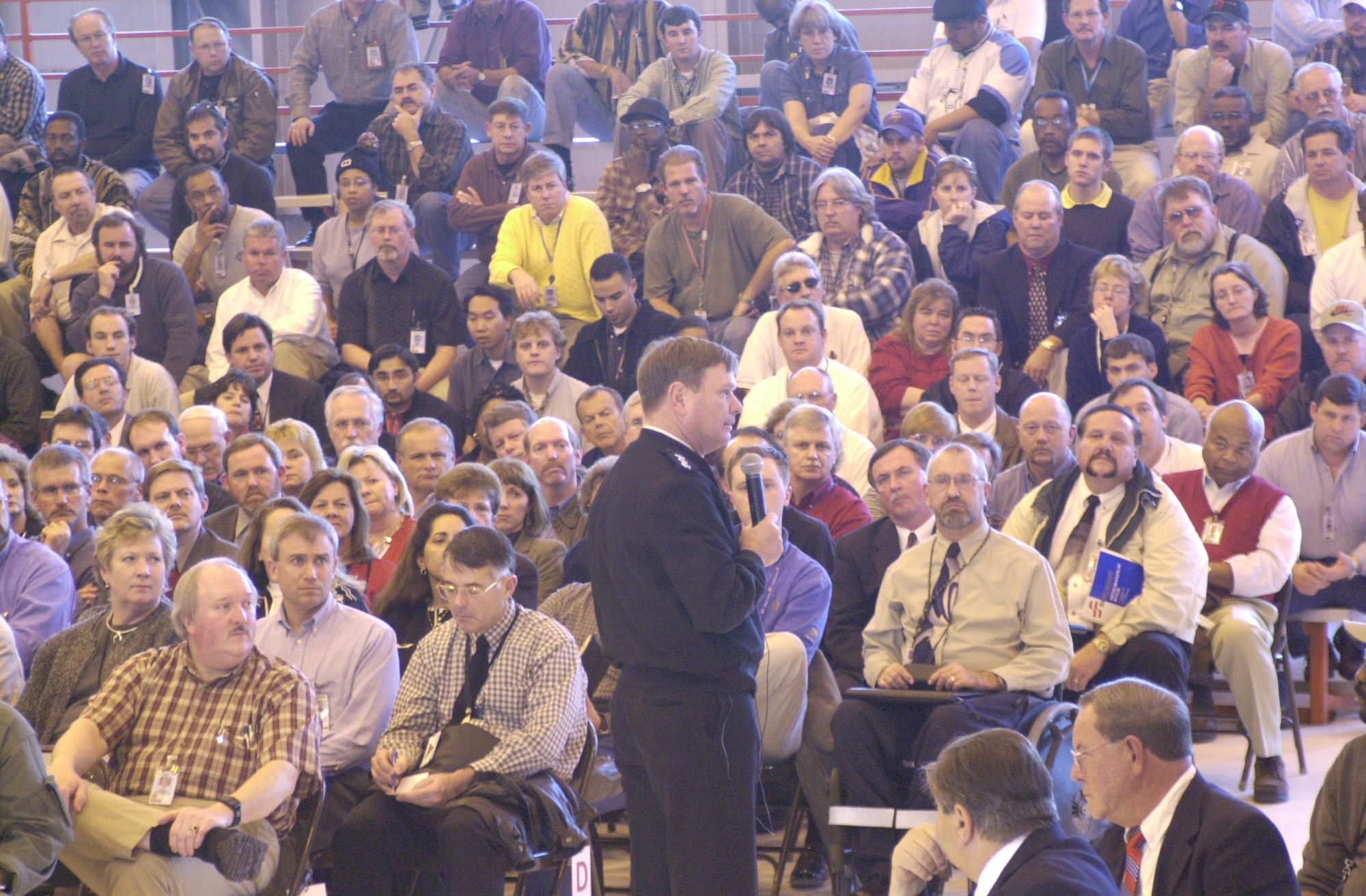
NAVAIR DEPOT CHERRY POINT -- Vice Admiral Walter B. Massenburg is a man with a vision. He wants to know – do you share that vision with him? The new commander of the Naval Air Systems Command asked that question to hundreds of employees in a crowded hangar here Dec. 16.
Although Massenburg visited during the depot’s 60th anniversary, it was clear that, like NADEP Commanding Officer Col. John Gumbel, his focus was not on the past 60 years, but on the future.
His vision: “We exist to provide cost-wise readiness and dominant maritime combat power to make a great Navy/Marine Corps team better.”
It’s fair to assume that the admiral already had this vision in mind when he pinned on his third star Dec. 1. When faced with the initial challenge by the Chief of Naval Operations to help us create and sustain a “culture of readiness,” the new commander began by spelling out his vision in a Dec. 4 message to all hands in NAVAIR.
He will use visits like this one to reinforce his plan by making sure that everyone, from top management personnel to the working teammates on the hangar floor, gets the message and gets the point.
The average depot-level employee might wonder how “a member of the brass” could have a real link with the man with a wrench in his hand. The answer: he knows what the fleet needs because he’s been there. NADEP Cherry Point had not even completed its first 30 years when a young naval aviator named Massenburg first began flying the aircraft that were repaired at facilities like the depot here. Since then, more than three decades of aviation-related assignments nurtured the vision into a solid plan for the future of naval aviation.
At Cherry Point, the admiral took it a step further – he translated his NAVAIR vision into what it means to the people who work at this level. He began with questions to see if employees understand what their vision and goals are here in the depot.
“The vision is an organic depot capability, which you all have, to provide unsurpassed products and service to the fleet,” Massenburg explained to the assembled employees. “It’s simple, it’s straight forward, it’s direct – and it creates a direct connection between every employee here and every sailor and Marine in the fleet you support. There is no more personal relationship than you working on airplanes to give them the products to fight in the war.”
The admiral praised Cherry Point employees’ support of the warfighter, saying, “Three wars: Enduring Freedom, Iraqi Freedom and the global war on terrorism – and you all have the most wonderful products that our kids are out there flying and fighting with.”
Looking ahead, Massenburg listed the goals that employees should have here. “Number one … improve reliability … because if you fix something and it goes out there and it doesn’t work, what happens? The work to take that thing off an airplane and replace it falls on the backs of your Marines – a very personal relationship when you deal with reliability.”
Improved reliability, in the admiral’s view, includes improving the system to return information to artisans on the work that they’ve done so that they can do it better.
The second goal, noted the admiral, is improved cycle time. “You guys are champions at this,” he said, pointing out the efficient work being done in the H-46 hangar only a stone’s throw from the meeting.
Knowing the cost came next on the list. “I’d say reducing cost is something that we all need to be attuned to, but first you need to know what the cost is,” Massenburg explained. “You have to know what the cost is, know the cycle time and know the reliability before you ever go on the journey to reduce cost.”
The fourth goal is commanding officer and executive officer accountability/responsibility. In short, according to the admiral, that means “knowing what you are doing so I can fire you or help make you successful.”
Last on the list was material management. “It’s about an alignment of material management and maintenance that will make us better and more efficient.”
When the admiral asked if employees thought that the goals that he has for NAVAIR Systems Command would change the vision and goals of this depot, he surprised them with the answer of – no. “Because you have an eight-month head start on the way that NAVAIR is going to change the way they do business,” he said, referring to changes that were put into place when he took the position of Assistant Commander for Aviation Depots earlier this year. “You all lead that charge,” he said. “The comments and the words and the vision statements may be different, but the bottom line is that what you do at the depots is exactly that vision and the goals we just went over.”
“I have no intention, whatsoever, of changing your goals in the depots for the next three years, period,” he said. “You’ve got to work on those things – increased reliability, decreased cycle time, cost, leadership accountability and responsibility, and material management.”
When Massenburg moved the subject from the depot’s vision to his vision for NAVAIR, he pointed out that what has to occur is a balance. “What I think NAVAIR should be about is today’s readiness, tomorrow’s readiness and our future.” This belief is the foundation of the new NAVAIR vision.
Broken down into simple terms, his vision is to: Balance current and future readiness; to reduce the cost of doing business; to improve agility; to ensure alignment; and to implement Fleet-driven metrics.
“If we’re ever going to afford today’s readiness, and get the cost for the challenge of tomorrow’s readiness, then we have to take this journey,” said the admiral. “And we intend to do it.
“The bottom line becomes … each individual in our organization should question what they do as far as reliability is concerned, as far as cycle time is concerned, and how you reduce the cost of doing our business so that we can afford tomorrow, while we take care of today in a balanced way.”
-30-
Cutline -- Vice Adm. Walter Massenburg, NAVAIR's new commander, talks with NADEP Cherry Point personnel about his vision for the future of NAVAIR. (Photo by Mike Barton)