
China Lake icon moves on to next challenge
By Renee Hatcher
NAWCWD Public Affairs
NAWCWD’s resident expert in systems engineering, missile guidance and control, modeling and simulation, and operational analysis, Dr. Bob Smith, closed out his 38-year civil service career this week.
Originally from northeast Ohio, Smith first came to China Lake in 1969 as a summer hire and worked on simulations and math models for Sidewinder. He enjoyed the work and visited a lot of places that summer because he thought, “I’m never coming back here.”
Smith went back east and finished graduate school just as the aerospace industry was collapsing and Ph.D.s were selling hotdogs. With a book full of job rejections from industry and a standing offer to return to China Lake, Smith made his way back to the desert in 1971.
‘The first time I came here, I was in shock; it seemed so desolate,” Smith said “You soon find out that there’s a whole lot more here than meets the eye.”
A fly-fishing enthusiast, he was quickly hooked on the unique and challenging work at China Lake. Smith has held a variety of technical, management, and leadership roles on major programs such as the Joint Strike Fighter, the Sidewinder AIM-9X, AIM-9R, and AIM-9L missile variants, and the Advanced Common Intercept Missile Demonstration.
“I couldn’t have found a better place to work,” he said.
Most recently, Smith served as the chief engineer in the Weapons and Energetics Department (4.7) and led the Horizontal Integration and Capability Assessment Process (HICAP) initiative. HICAP looks at the whole kill-chain from surveillance to assessment to identify war fighting mission capability gaps in programs of record and presents these finding to the OPNAV resource sponsor as candidates for corrective action.
“Dr. Bob is nationally recognized and internationally acclaimed for his expertise,” said Dave Janiec, 4.7 director. “He has been the driving force behind several initiatives to ensure our nation’s technical eminence in the weapons community.”
Smith and his wife, Julie, will remain in Ridgecrest and he will be coming back as an intermittent rehired annuitant. He will work part-time teaching new employees, mentoring, and consulting on various projects.
“I want to give our new employees some insights and examples that will help them understand the kind of issues they will face here,” he said.
Sharing what he has learned with the younger engineers is important to Smith. To them he advises, “carve time out for yourself, be visible, and don’t be afraid of briefing people.”
He talked about the value of failing.
“Politically, it’s not good to have a failure,” he said. “But from an engineering perspective, that’s where you learn the most.”
Smith will not be short on things to do after retirement, and looks forward to his first grandchild early next year. He plans to work with the Naval Museum of Armament and Technology on education outreach projects that focus on kids at the middle school level.
“That’s going to be more nerve-racking than giving a flag-level presentation,” he said.
He also plans to get back into fly-fishing, radio-controlled airplanes, and of course will continue running, which he had done for 40 years.
Anyone traveling main side in the middle of the day has probably seen Smith and his noontime runners group. The runners have varied over the years but Smith and NAWCWD Executive Director Scott O’Neil have been two of the most dedicated.
“I mark that as one of the best things I’ve done here,” he said. “You get the physical benefits and it’s also a mental catharsis.”
Smith’s last official day was Nov. 2. A Halloween-themed party was held on Oct. 30 to celebrate his career at China Lake.
“I didn’t want a typical retirement party with plaques,” Smith said. “My career was enough of a gift.”
PHOTO CUTLINE
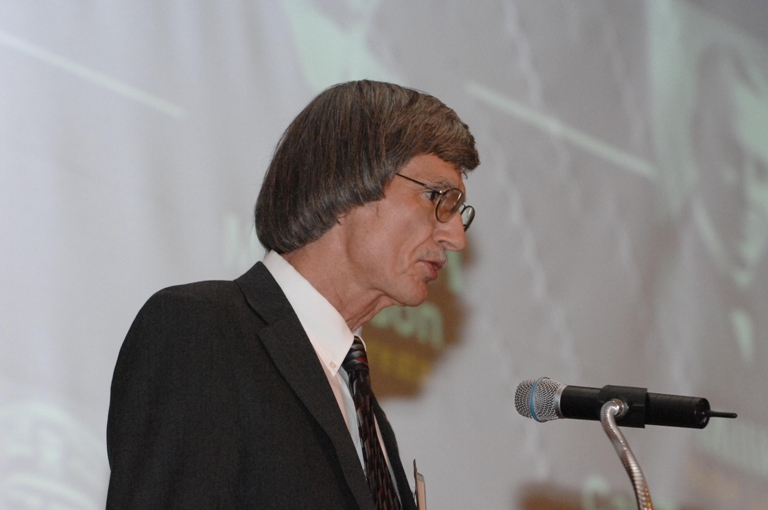
Dr. Bob Smith delivers a multi-media presentation at the U.S. Naval Academy in 2007 for the 100th anniversary celebration of Albert A. Michelson receiving the Nobel Prize.