Empire Challenge wraps up at China Lake
By Theresa I. Goldstrand
Weapons Engagement Office
Empire Challenge 2008 (EC08), an event led by the U.S. Joint Forces Command (JFCOM) and the National Geospatial-Intelligence Agency (NGA), wrapped up a month’s worth of real time interoperability exercises at NAWCWD China Lake involving military and civilian counterparts from the United States, Australia, Canada and Great Britain.
Facilitated by the NAWCWD Weapons Engagement Office (WEO), EC08 focused on improving joint and coalition non-traditional intelligence, surveillance and reconnaissance (ISR) systems operations as well as persistent surveillance, joint targeting, multi-domain awareness, and counter-IED.
“EC08 surpassed all previous events when considering the digital kill chain as utilized by the non-traditional ISR/strike mission threads,” said Wayne Willhite, head of the NAWCWD WEO. “The systems necessary to request, task, collect, receive, and exploit information are all working in a “4-eyes” environment. The primary focus for the second half of the EC08 event was the operational employment of a full digital, real time environment.”
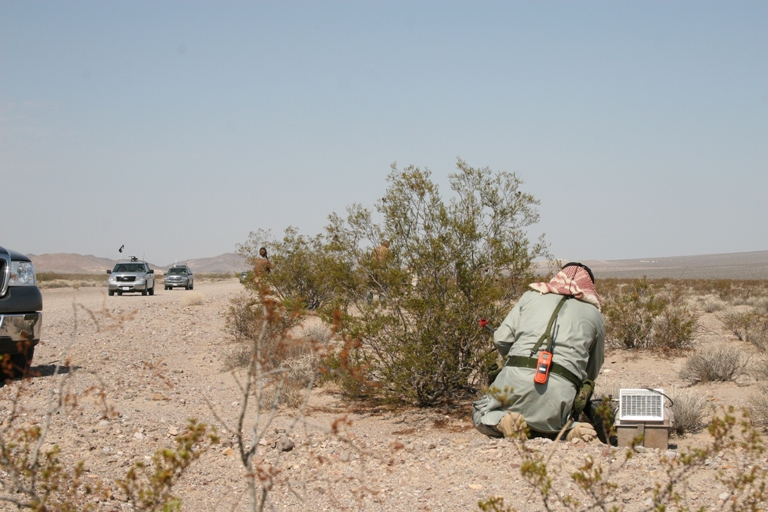
China Lake’s million square miles of air space, its desert environment similar to that found in the U.S. Central Command’s theater of operations, and its ground testing assets again made it the desired location for the fifth Empire Challenge. At China Lake, intelligence analysts and other participants observed realistic ground events such as simulated sniper attacks, village and convoy attacks, manned and unmanned aircraft video provided by U.S. and coalition forces to capture imagery, electro-optical, infrared, and synthetic aperture radar imagery products.
EC08 demonstrations proved a U.S. ground station can link to allied ground stations in real time. This integration allows coalition commanders to develop situational awareness in a much faster timeframe. All of the exercises completed during EC08 allow decision makers to develop a truly network-enabled enterprise capability.
About 1,500 contractors, military, and civilian Department of Defense employees assisted in the exercise, as well as about 250 coalition allies. NAVAIR reserve forces played key roles as live opposition forces, and digital kill-chain experts on the blue (friendly) side of the force. They manned stations in the Combined Air Operations Center, performing both intelligence and operations functions.
One of the desired outcomes of EC08 was to develop a more accurate and meaningful common intelligence picture by identifying and correcting interoperability issues with our allies. Throughout Empire Challenge, participants merged various types of intelligence, regardless of the source, to improve ISR systems, in real-time and to improve command and control systems.
EC08 consisted of several integration sites including all U.S. Armed Service Distributed Common Ground Services (DCGS) programs, U.S. national intelligence community labs, JFCOM, Joint Systems Integration Center (JSIC), Joint Interoperability Test Center (JITC), and allied partner intelligence centers. About 148 aircraft sorties were conducted during the month of July. American and British air assets included JSTARS, UK ASTOR, AWACS, E-2C (Fleet and XHAWK), Rivet Joint, U2, Global Hawk, numerous unmanned aerial vehicles, F/A-18 E/F/G series, and LSRS.
Once again, NGA’s Cmdr. Joseph Smith headed up the event.
“This exercise looked at the equipment and systems that processed information that came down from our ISR assets, UAV and manned aerial vehicles,” Smith said. “Basically, each country worked to obtain applicable information and systems that would benefit their country, and improve the interoperability of systems with their closest allies. The ‘demonstration series’ of EC08 was designed to test and evaluate intelligence gathering techniques and procedures for joint and coalition war-fighting operations. We used traditional and non-traditional ISR assets to figure out how to get information to tactical forces around the world and how to use that information.”
Empire Challenge participants are constantly examining efforts toward achieving U.S. and allied interoperability within the DCGS architecture. They managed to assess and highlight geospatial intelligence support to the operations, and to test and evaluate non-traditional intelligence, surveillance and reconnaissance assets and multi-intelligence fusion capabilities to analyze results and possible benefits to the warfighters and decision makers.
“EC08 was a success,” said Pamela Tillery, Electronic Combat Range (ECR) test manager. “I had an outstanding rapport with the coalition forces. We provided logistical and facility support as well as the desert environment, at China Lake and ECR that they needed for their pre-deployment training. This allowed them to test their equipment and manpower under more realistic conditions.” Tillery conducted range safety briefs and reported there were no personal injuries or incidents during the exercise.
SKC Dana Lyon and fellow officer and enlisted reservists from Naval Air Systems Command 6066 Detachment B traveled from Minneapolis, Minn. to participate in EC08.
“Playing with ordnance last year was a blast, literally,” said Lyon, a two-year veteran of Empire Challenge. “We coupled old fashioned ‘boots on the ground warfare’ with high tech intelligence assets. My personnel are enjoying playing both the red and blue force sides of the fence. Several of our folks said it was the most exciting annual training they had experienced. This past winter, we drilled in minus-37 degree weather and now we’re in temperatures up to 117 degrees. Talk about extreme weather conditions.”
PHOTO CUTLINES
Photo by Joy Lewis
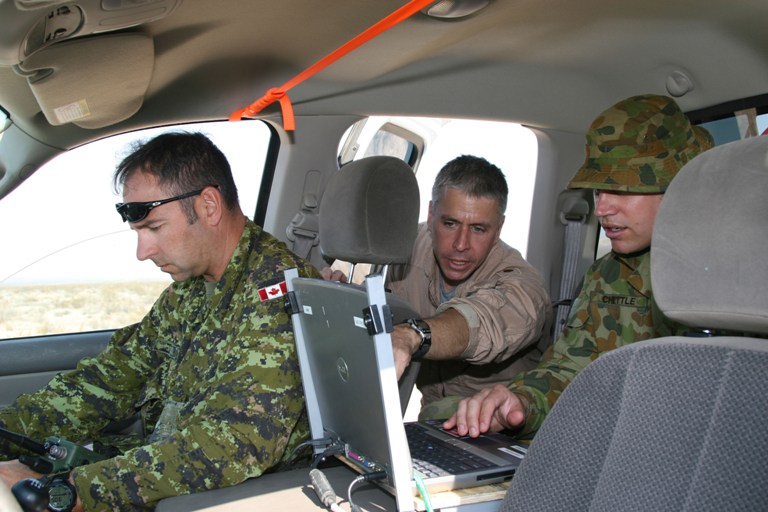
Cmdr. Pete Milham, center, reserve commander for Digital Kill Chain Test and Evaluation Unit 0366 Det. B of NAS Fallon, trains Canadian coalition partners on precision targeting field software during Empire Challenge 2008 at NAWCWD China Lake.
Photo by Joy Lewis
NAVAIR reserve forces play a key role as live opposition forces during Empire Challenge 2008 at NAWCWD China Lake, where the desert environment is similar to that found in the U.S. Central Command’s theater of operations.
Photo by Joy Lewis
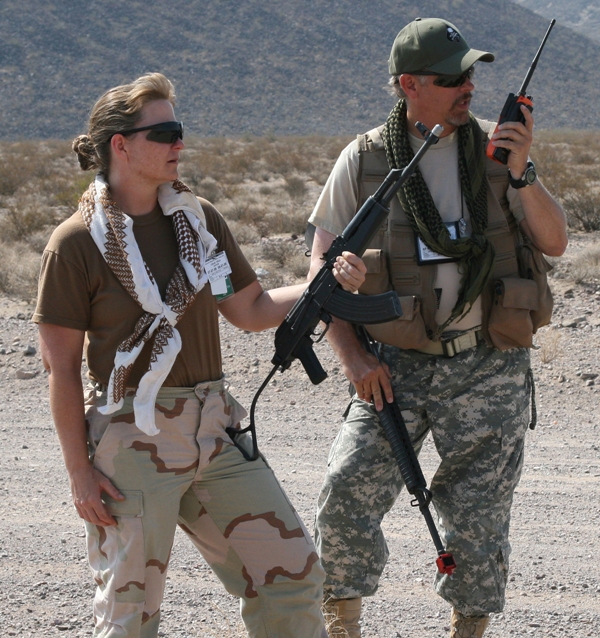
IS1 (SW/AW) Leslie Viola and Richard ‘Doc’ Burklund of JFCOM traveled from Norfolk, Va. to take part in Empire Challenge 2008 at NAWCWD China Lake. About 1,500 contractors, military, civilian Department of Defense employees, and 250 coalition allies participated in the fifth annual exercise.