
Hintz gets second NATO award
By Renee Hatcher
NAWCWD Public Affairs
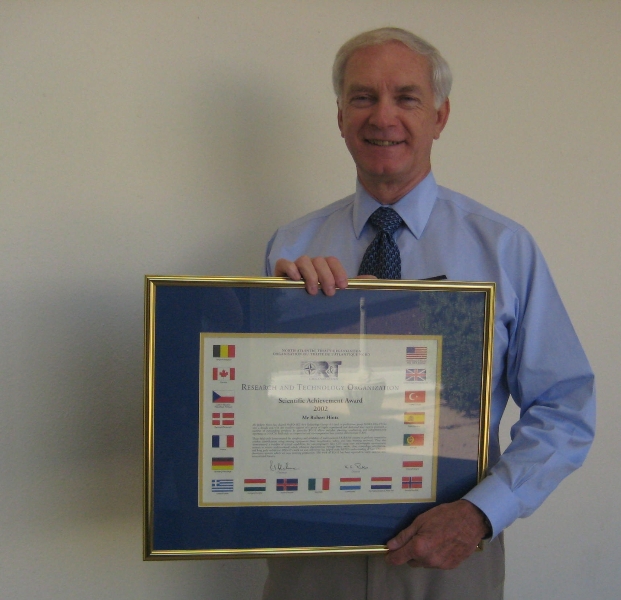
NAWCWD scientist Bob Hintz is the first person to receive two NATO Scientific Achievement Awards and may be in the running for a third.
“This award is the result of great collaboration,” Hintz said. “The sharing of emerging technology between our U.S. armed services and our allies is critical. If we work together, we all can benefit.”
Hintz, chief technologist for electro optics and chief engineer for sensor systems in NAWCWD’s Avionics Department, was the chairman of NATO Sensor and Electronics Technology Panel 077 Research Technology Group-45 (RTG-45) that won the achievement award for its work on military applications of laser radar technology.
The Scientific Achievement Award is the second highest level of technical recognition given by NATO. Dr. Reinhard Ebert, from FGAN FOM in Germany, accepted the award for Hintz, who could not attend the award ceremony Sept. 24 in Bucharest, Romania.
Hintz, who was recruited by the engineering department through the Junior Professional Program at China Lake 40 years ago, began working with NATO in the early ‘80s. His first NATO award came in 2002 as a result of his work with this team (at that time titled RTG-11). That group focused on cooperative and non-cooperative laser techniques for combat identification including laser vibration sensing. NATO recognized the team’s achievements in long-path (80 kilometer) turbulence measurements conducted at China Lake in July 2001. This test included coherent laser systems operating at three eye safe wavelengths, and used three independent techniques to characterize scintillation and turbulence. This achievement was only possible by combining the resources of five NATO nations.
After RTG-11’s four-year term of performance ended, Hintz received approval for RTG-45, and began looking at laser radar 3-D signatures of land vehicles. RTG-45 included representatives from the U.S. Army and Air Force as well as nine NATO countries.
“The work we did on automatic target recognition using laser radar signatures was a very useful collaboration,” said Hintz, who has noticed that the NATO environment has changed since he first got involved.
“The other countries used to come to the meetings just to hear what the United States had to say; we were doing all the things they wanted to do,” Hintz said. “Twenty years later, I go to these meetings to find out what they are doing. A lot of advanced technology is happening in Europe, and these NATO groups give us an opportunity to incorporate some of the smart things they are doing into our work.”
Hintz is currently leading another NATO research group. This one is looking at using LADAR ATR for maritime targets, something that hasn’t been done before. The group has already built a database on about 1,000 ships, and has a test planned for early next year with six different countries set to demonstrate their 1-, 2-, and 3-D laser radars.
“I suppose we could win again with this group,” Hintz said.
PHOTO CUTLINE:
NAWCWD scientist Bob Hintz, who earned his first NATO award in 2002, added a second award to his collection this year.