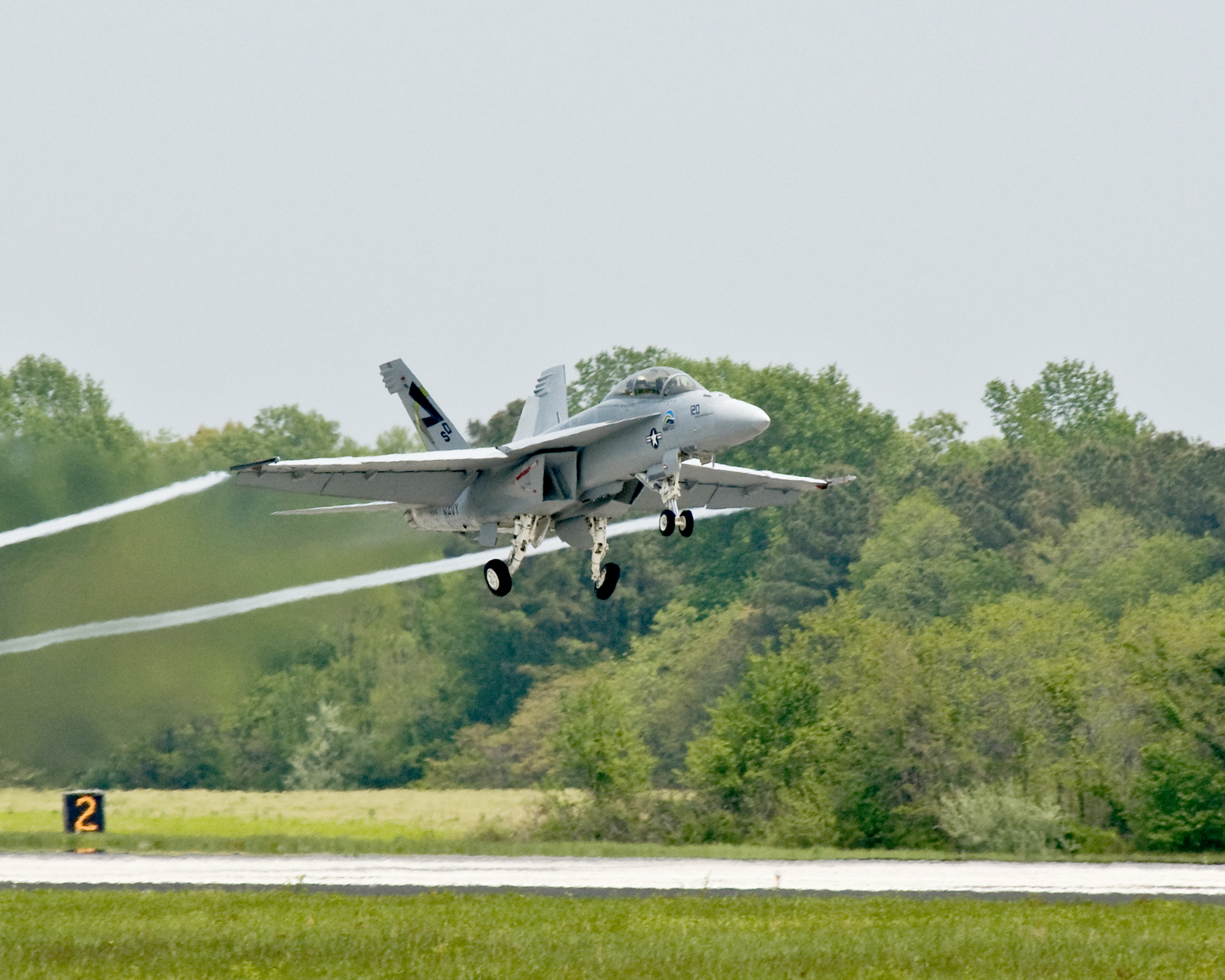
The Navy celebrates Earth Day by showcasing a supersonic flight test of the "Green Hornet," an F/A-18 Super Hornet strike fighter jet powered by a 50/50 biofuel blend. The test, conducted at Naval Air Station Patuxent River, Md., drew hundreds of onlookers that included Secretary of the Navy Ray Mabus, who has made research, development, and increased use of alternative fuels a priority for the Department of the Navy. (U.S. Navy photo by Kelly Schindler/Released)
Navy tests biofuel-powered “Green Hornet”
The Navy celebrated Earth Day on April 22 by showcasing a flight test of the “Green’ Hornet,” an F/A-18 Super Hornet multi-role fighter jet powered by a biofuel blend. The test, conducted by the Naval Air Systems Command at Naval Air Station Patuxent River, Md., drew hundreds of onlookers, including The Honorable Ray Mabus, Secretary of the Navy, who has made the exploration and adoption of alternative fuels a priority for the Navy and Marine Corps.
Mabus observed the flight and tracked its data from a Project Engineering Station at the Atlantic Test Range. After the jet landed, he met the pilot, Lt. Cmdr. Tom Weaver of Billerica, Mass.
"The alternative fuels test program is a significant milestone in the certification and ultimate operational use of biofuels by the Navy and Marine Corps,” Mabus said. "It's important to emphasize, especially on Earth Day, the Navy's commitment to reducing dependence on foreign oil as well as safeguarding our environment. Our Navy – alongside industry, the other services, and federal agency partners, will continue to be an early adopter of alternative energy sources.”
The ‘Green’ Hornet runs on a 50-50 blend of conventional jet fuel and a biofuel that comes from camelina, a hardy U.S.-grown plant that can thrive even in difficult soil.
The Defense Energy Support Center, which oversees procurement of biofuel for the Navy, recently awarded a $2.7 million contract to Sustainable Oils of Seattle and Bozeman, Mont., for 40,000 gallons of camelina-based fuel. The Navy's ultimate goal is to develop protocols to certify alternative fuels for use in its aircraft and ships.
"The aircraft flew exactly as we expected – no surprises," said Weaver, F/A-18 project officer for VX-23 and pilot for the Earth Day flight test. “The fuel works so well, all I needed to do was just fly the plane.”
"Our mission today and for the rest of the flight tests is to confirm that the fuel makes no difference in performance across the Super Hornet's entire flight envelope, from subsonic to supersonic operations," said Mark Swierczek, NAVAIR propulsion flight test engineer. “Preliminary results show there was no difference in engine ops attributable to the biofuel. Engine performance is normal and as expected.”
The Navy Fuels Lab at Patuxent River is developing certification standards for a variety of renewable, alternative fuel sources.
"These flight tests are part of an extensive test and evaluation process that started last fall," said Rick Kamin, the Navy's Fuels Team Lead. "The fuel’s chemical and physical properties were first analyzed in the lab, followed by component and engine performance testing - and now in a series of flight tests covering the entire flight envelope of the Super Hornet – including supersonic operations.”
According to Kamin, final approval and certification for the camelina-based biofuel could take an additional six to nine months after today’s flight test event. The Earth Day flight test is one of 17 planned test flights requiring approximately 23 flight-hours to complete, starting in mid-April and completing by mid-June 2010. The Earth Day flight lasted about 45 minutes.
The Green Hornet biofuel program is the first aviation test program to test and evaluate the performance of a 50/50 biofuel blend in SUPERSONIC (above mach 1) operations – a critical test point to successfully clear the F/A-18 E/F for biofuel operations through its entire flight envelope. Once successfully demonstrated on the F/A-18 F414 engine, the Navy will expand its certification efforts to other Navy and Marine Corps aircraft and Navy tactical systems.