

Employees from the Ready Missile Test Facility gather with Anthony Briones (fifth from right) and Naval Air Warfare Center Weapons Division Executive Director Dan Carreño (far right) following Briones’ 35-year length-of-service award presentation Aug. 26 in Point Mugu, Calif. (U.S. Navy photo by Kimberly Brown)
The therapeutic touch: When missile repair became Briones' therapy
Anthony Briones remembers the T-shirt. A coworker at the Ready Missile Test Facility wore it years ago. On the shirt, an ordnance tech sprints with the caption, "If you see me running, follow me."
Dark humor masks deadly reality. Ordnance technicians get no second chances.
In 35 years, Briones has never had to run.
"I have been faithful to my job. I followed the rules and lived up to our standards," Briones said.
Today, the engineering technician sits at his desk, tracking missile serial numbers through spreadsheets. On paper, that is the title. Ask him, and he offers a different one.
"I call myself an ordnance mechanic," Briones said. "I love working on ordnance and I love working on missiles."
A dozen AIM-120 Advanced Medium-Range Air-to-Air Missiles, commonly known as AMRAAMs, crowd the bay, awaiting teardown and troubleshooting. Each arrived with a discrepancy report from the fleet. Wire harness failures. Bad rectifier filters. Software glitches. Problems the fleet cannot fix.
He no longer does the repairs himself. That is the team's job now. After nearly 40 years, Briones has evolved from the mechanic who found peace in missile repair to the lead on AMRAAM, ensuring every weapon works when warfighters need it most.
"That missile could be the determining factor in an air battle," Briones said. "Just that one missile."
That is why he shows up. That is why the years flew by.
"Between the learning, the research and the work, my days went fast," Briones said. "Thirty-five years felt like a blur."
The father's shadow, the son's path
His father served in the Air Force, then became a Navy Seabee.
"I remember my dad going to Vietnam and coming back from Vietnam," Briones said. "When my dad retired from the Navy, I retired from the Navy because he was on so many deployments."
Briones planned to follow in his father's footsteps as a Seabee. The Navy recruiter tagged him as a legacy Seabee. But his father intervened: "If you plan on having a family later on, the Air Force will be a little more stable."
In 1981 he joined the Air Force as an aircraft armament systems specialist, loading live ordnance on A-10s and F-15s.
Then in 1986, he left active duty and drove from Eglin Air Force Base in Florida to Oxnard, California, a drive of 2,500 miles.
Complete uncertainty. No job waiting. No plan beyond arriving. Just faith that ordnance experience meant something.
Though his active duty ended, military service continued. Briones joined the Army National Guard from 1986 to 1988, then transferred to the Air National Guard, retiring to inactive reserve status in 2005.
The one phone call
Three weeks after leaving the Air Force, Briones sat in the unemployment office. The veterans representative flipped through his file, then stopped partway through a page.
"You loaded missiles on aircraft?" the representative asked.
The representative made a call. His friend Larry Young, a retired Navy chief at the Ready Missile Test Facility, needed people with ordnance experience.
"Send him over," Young said.
One phone call. That is all it took.
Briones was interviewed the next day, and by April 1986, he had found his answer at RMTF, starting as a contractor ordnance mechanic.
His bench became a catalog of American weapons: Harpoon, Phoenix, Tomahawk, HARM, SLAM-ER, AMRAAM.
From 1986 to 1992, he learned every system, every quirk, every failure mode.
In June 1992, he left RMTF for 11 months to join his father's plumbing business in Albuquerque, where he worked on custom two-story homes in the desert. He finally learned trades he had wanted ever since his dad steered him to the Air Force instead of the Seabees.
But missiles pulled him back. He returned to RMTF in May 1993, worked as a contractor and then converted to civil service in 1995.
Learning the Navy way
His civil service career began with managing missiles rather than repairing them.
"It was a dream for me to get into civil service," Briones said. "Point Mugu was hopping when I returned."
The Weapons Department assigned him to work as a materials handler in the ordnance storage magazines, where he was responsible for millions of dollars' worth of weapons, including aging Sparrows, bombs, ammunition and the latest SLAM-ER variants.
"I learned Navy ordnance in the magazines along with the lingo and everything else," Briones said. "It prepared me for the rest of my career."
From 1999 to 2005, he became an expert on Sparrow and maintained test sets for the Navy and the Air Force. The test sets run quick electrical checks that take about three seconds, and they load software updates to confirm missiles are mission ready.
"The Navy has invested a lot of money to maintain these weapons and keep them going and keep the numbers in the fleet," Briones said.
The work took him overseas, where he trained allied forces in the Netherlands, Portugal, Greece and Australia. Each service approached maintenance differently, but the Navy culture of in-house repair set it apart. The Navy fixed what others shipped back to contractors, saving millions in the process.
Finding peace in precision
When base realignment sent Sparrow operations to China Lake in December 2005, he returned to RMTF for AMRAAM, which became his specialty for the next 20 years.
"It was therapeutic," Briones said. "If I had trouble at home, I came through the gate knowing I would repair missiles. That has been my driving force."
One belief has driven Briones forward in his career.
"I felt good about repairing missiles and turning them around for the fleet as soon as possible," Briones said. "That drove me for years."
Briones had settled into this rhythm. Twenty years of repairs. Twenty years knowing his role.
The unexpected promotion
Then, in March 2022, the AMRAAM team lead walked out. No warning. No handover. Missiles allotted for contracts nobody knew existed.
Mike Kennedy needed someone who understood both missiles and mission. He found Briones at his desk.
"Tony, we want you to be the AMRAAM leader," Kennedy said.
Briones looked up. Twenty years of repair work. Twenty years knowing every wire harness, every failure mode. Never the paperwork guy.
"You want me to do that?" Briones asked.
"Yeah, we know you can do it," Kennedy said.
Kennedy knew exactly who he needed.
"Tony has always been right at the top," Kennedy said. "He is truly someone you can trust to support the warfighter and lead the team."
It took him away from having his hands on the missiles. But the team trusted him. That mattered more. And for Briones, this became one of the defining moments of his career.
"That was a good thing because it told me that, as a team member and a team leader, the crew respected me and I could get things done," Briones said.
Nine people, one mission
China Lake logistics calls Briones their AMRAAM subject matter expert.
Kennedy leads a team of nine technicians at RMTF, who handle depot-level AMRAAM repairs for the entire U.S. Navy.
Nine people. Not nine hundred. Not nine teams. Nine.
"People do not know about us," Briones emphasized. "You do not hear anything about Ready Missile Test Facility. Whenever we go anywhere to do repairs, they only know us by Point Mugu."
The Navy never has enough missiles in inventory. Every broken AMRAAM means one less weapon for the fleet. When a missile fails anywhere, it comes to Point Mugu. Aircraft carriers in the Pacific. Bases in Japan. Squadrons in Virginia. No backup team exists. No other facility performs this work.
"We always have an inventory issue with any weapon," Briones said.
When reports of missile failures arrive at China Lake, logistics specialists make a critical decision: send them to Raytheon for expensive contractor repair or send them to Point Mugu for Kennedy's team.
"I mean, we are the team people go to," Briones said.
They have completed around 1,500 AMRAAM tests, running test sets that verify every circuit before a missile returns to the fleet. Repairs done in house have saved the Navy millions of dollars. They have traveled to Guam, Europe and Bahrain, wherever American forces or allied nations need them.
Passing the torch
Today, he teaches and delegates, making sure his successor will not face the confusion he inherited.
"I have told them who I would like to take over," Briones said of his December 2025 retirement. "I did not want a repeat of the last transition where the lead left without a handover."
Ask Briones about recognition, and he waves it off.
"I am not here for recognition and neither are these guys," Briones said. "I am satisfied knowing I can return a good weapon to the fleet and that it will do what it is supposed to do. That is the recognition I like."
His philosophy did not change. Get weapons back to warfighters fast. Every delay creates vulnerability. Every repair builds readiness.
The younger technicians remind him of himself when he first started.
"I wanted to do all kinds of stuff to contribute and be a part of the team," Briones said. "And now all I am doing is giving advice, training others and passing on the knowledge."
The final inventory
Kennedy watches Briones prepare for retirement with mixed emotions.
"I have never worked with a more mission-oriented, ready to support, and go anywhere needed person than the team at the Ready Missile Test Facility," Kennedy said. "When he retires, he will be greatly missed."
Thirty-five years. Thousands of missiles. A flawless safety record.
Briones never had to run because he never made mistakes with weapons that offer no second chances.
As his December retirement approaches, what remains after nearly four decades of keeping America's missiles ready?
"I want them to know I did my job. I knew my craft," Briones said. "I kept missiles in the fleet by repairing them."
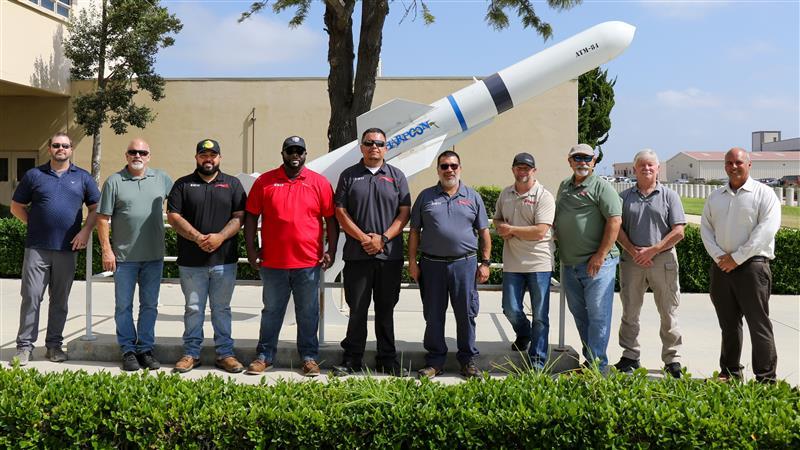
Employees from the Ready Missile Test Facility gather with Anthony Briones (fifth from right) and Naval Air Warfare Center Weapons Division Executive Director Dan Carreño (far right) following Briones’ 35-year length-of-service award presentation Aug. 26 in Point Mugu, Calif. (U.S. Navy photo by Kimberly Brown)
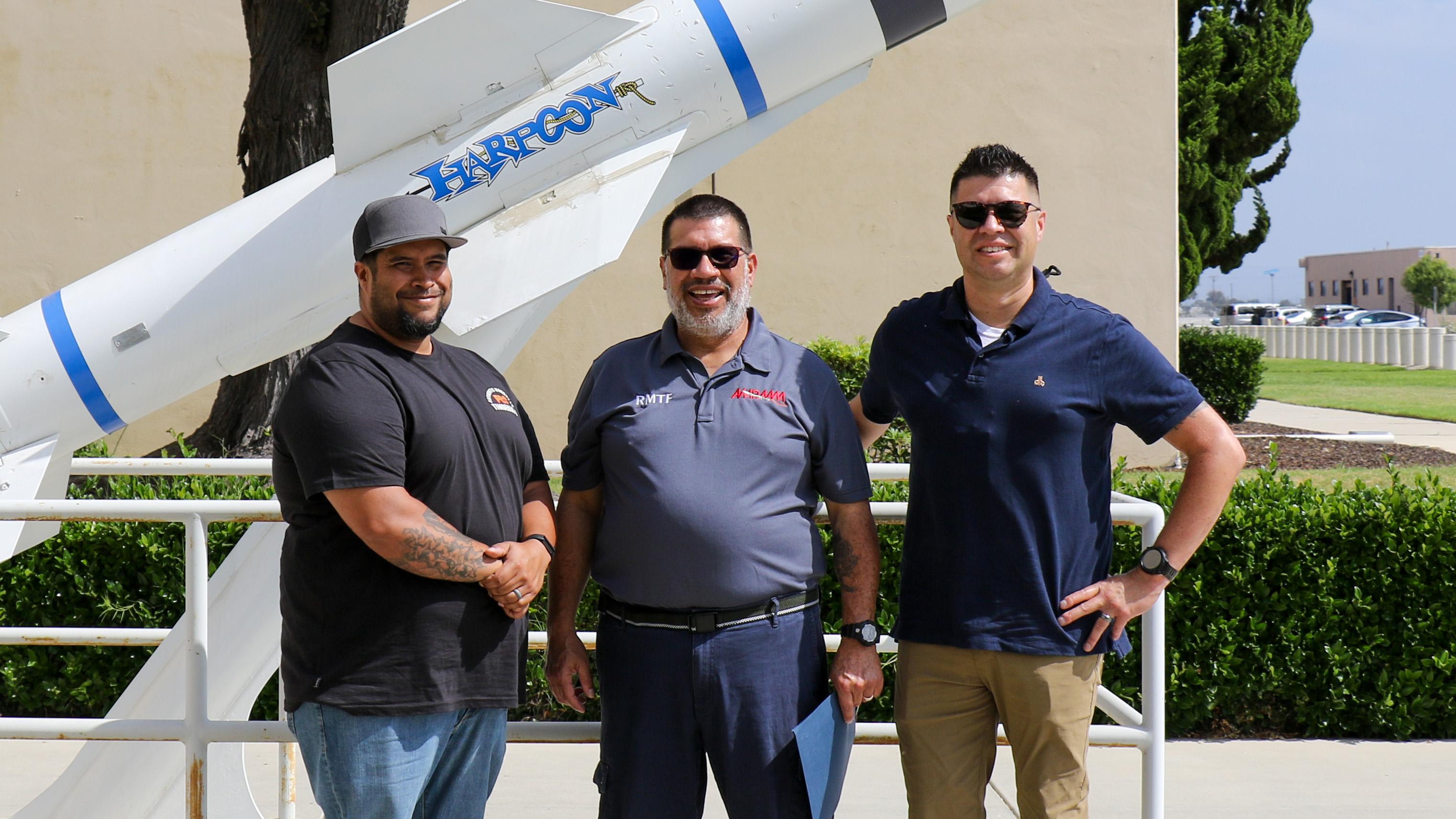
Anthony Briones (center) stands with family members following his 35-year length-of-service award presentation Aug. 26 in Point Mugu, Calif. (U.S. Navy photo by Kimberly Brown)