
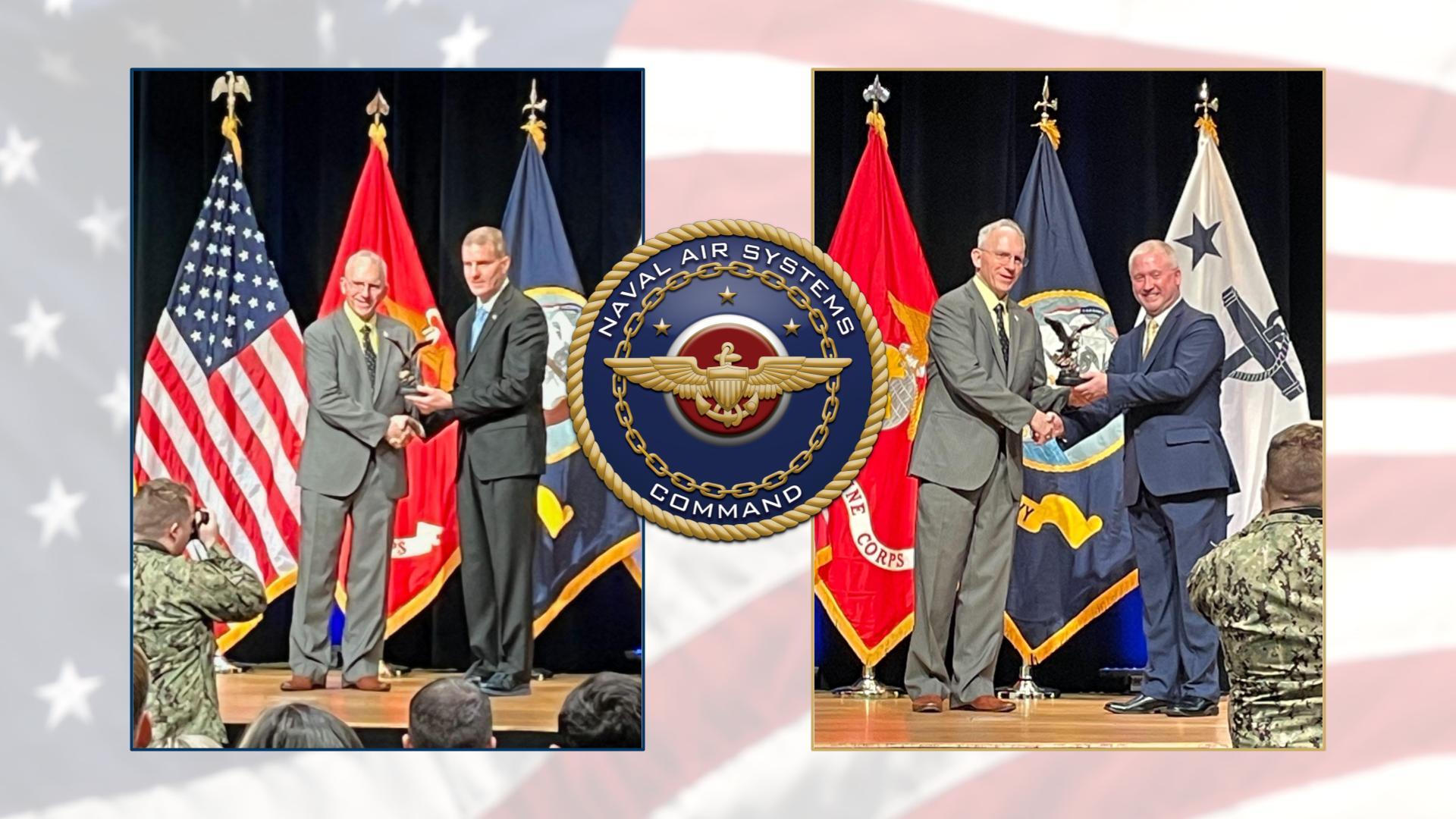
(Left photo) Assistant Secretary of the Navy (Research, Development and Acquisition) Nickolas Guertin, left, presents Edward Henderson with the DON Acquisition Excellence Award, Product Support Manager of the Year – ACAT I.
(Right photo) Assistant Secretary of the Navy (Research, Development and Acquisition) Nickolas Guertin, left, presents Terry Duggan with the DON Acquisition Excellence Award, 2023 Product Support Manager of the Year – ACAT II and Below.
Two Sustainment Group PSMs capture DON awards for excellence
Two Naval Air Systems Command (NAVAIR) Sustainment Group product support managers (PSM) were recognized as winners of the Department of the Navy (DON) Acquisition Excellence Award, Product Support Managers of the Year at a ceremony in the Pentagon Jan. 10. Edward Henderson, PSM for the Naval Undergraduate Flight Training Systems Program Office (PMA-273), is the 2023 DON Product Support Manager of the Year – Acquisition Category (ACAT) I. Terry Duggan, PSM for the Naval Air Traffic Management Systems Program Office (PMA-213), is the 2023 DON Product Support Manager of the Year – ACAT II and Below.
Henderson and Duggan were two of eight civilians and teams from NAVAIR who were presented DON Acquisition Excellence Awards. Also recognized were the F-35 Foreign Military Sales New Business Team as the winners of the International Partnership Acquisition Award; Program Executive Office (PEO) Air Anti-Submarine Warfare, Assault and Special Mission Sonobuoy Acquisition Team as the Competition Excellence Acquisition Team of the Year; and PEO Tactical Aircraft Programs’ AV-8B ELEMENT 13 Team as the Innovation Excellence Acquisition Team of the Year. Lori Frame and Matthew Fernandes from PEO Unmanned Aviation and Strike Weapons, and Capt. Larry Smith, from the F-35 Lightning II Joint Program Office, were recognized as the DON Acquisition Professional of the Year for Contracting, Test and Evaluation and ACAT III/IV, respectively.
Assistant Secretary of the Navy (Research, Development and Acquisition) Nickolas Guertin commended all of the award winners for their achievements during the event.
“Today’s awardees reflect the critical importance of getting acquisition right throughout a program’s life cycle as well as delivering current and future capabilities to the warfighter,” he said. “Today’s awardees also reflect the Secretary of the Navy’s strategic priorities of strengthening maritime dominance, building a culture of warfighting excellence and enhancing our strategic partnerships. The work you do every day strengthens maritime dominance.”
“The entire acquisition workforce should feel empowered by the critical role you play in advancing these priorities,” he added. “I’m proud of all of the awardees and the teams that supported them.”
Henderson was acknowledged for his execution of the PMA’s cost-effective product support strategies. Tapping into the Naval Aviation Enterprise and Sustainment Group resources, Henderson introduced the Cost and Readiness Impact Model (CRIM) Tool into the PMA-273’s processes, reducing its total Program-Related Logistics requirements for more than 700 aircraft by over $72 million across the Future Years’ Defense Program when compared to Program Objectives Memorandum-24 validated requirements.
“The value of CRIM comes with understanding the true requirement. CRIM clarifies required support actions that facilitate and support an aggressive flight schedule across six type/model/series within our portfolio,” Henderson explained. “CRIM provides a clearer understanding of what projects and products that the program is funding. It also helps clarify the impact when a requirement isn’t funded.”
Understanding that readiness is also influenced by the ability of our industry partners to meet demand, Henderson used his logistics integration expertise and personal experience acquired over the course of his 26-year military and 16-year civilian career to the F405 Performance Work Statement review. More than 60 recommendations related to how the original equipment manufacturer would manage engine availability and respond to emergent issues were put forth. His efforts directly contributed to a cost savings of more than $379 million over a period of five years.
Henderson was also forward leaning, reaching out to the Chief of Naval Air Training to establish a readiness cell to bring together experts from all lines of support to quickly address aircraft concerns. Even though PMA-273 had yet to become part of the formal Naval Sustainment System – Aviation process (an effort managed by the Naval Aviation Enterprise created to achieve and maintain naval aircraft readiness goals by leveraging best practices across communities to drive improvements), he recognized how the approach could increase the availability of training aircraft in support of pilot production and was instrumental in standing up the readiness cell ahead of schedule.
Training and consistency are foundational to mission accomplishment, according to Henderson.
“Success tends to be personality driven, but if you want it to continue, it has to be process driven,” he said. “The key to fully mission capable aircraft is solid preventative maintenance. As a maintenance master chief in the Navy, I was able to influence, train and develop people to help them understand the importance of the ‘why’ behind what they were doing so that they would produce safe, quality aircraft. I instilled a culture of learning and adherence to the maintenance manuals for the Sailors and Marines I supervised. I stressed that ultimately, the goal is for the pilots to complete their mission and return home safely.”
“Training everyone - not just logisticians – in the PMA on these same ideas is what it takes to get results,” he added. “Teaching the team to use the instructions or references goes a long way toward meeting program goals.”
Tapping into one’s creativity when facing challenges is also crucial in the decision-making process, Henderson said. “Too often, we just bring up problems rather than offer solutions,” he explained. “I believe each of us has the responsibility to contribute recommendations or alternatives to get the mission or task accomplished.”
Duggan was named 2023 Product Support Manager of the Year – ACAT II and Below for his effort to capture multiple disparate fleet data reports/digital products and incorporate them into a single, coherent online system. This involved conducting data analysis and producing meaningful graphs and other visualization tools on the health of ship, shore and expeditionary air traffic and landing systems. This execution strategy was instrumental to the fleet achieving and sustaining an average overall system operational availability (Ao) of 98%, exceeding warfighter availability requirements by 2%, and 5% above the stated Ao requirement. In addition, he led the Combat Identification Air Logistics team’s stand-up of an organic repair capability at Tobyhanna Army Depot, Pennsylvania, for the APX-123/123A air traffic control transponder, reducing component repair costs by 50%.
Understanding a weapons system’s performance starts with gathering data directly from the system operators in the fleet, according to Duggan. “Operational data can differ from maintenance data. Identifying these differences and sharing the different metrics and perspectives with stakeholders is necessary to give a well-rounded, holistic picture of system performance,” he said.
“Also, different departments within the Navy and Marine Corps conduct their processes very differently from one another, even though on the surface it appears that they have commonality. Understanding these differences and the need for them have enabled me to see the bigger picture,” he added.
Duggan said he always seeks to stretch and challenge himself.
“Many famous speakers say that part of personal growth happens when one steps outside one’s comfort zone – that is where the magic happens,” he said. “I believe that to be true and I apply that philosophy to both my personal and professional life.”
Boldness, personal excellence and a willingness to learn are critical to any endeavor, according both awardees.
“Try to be the best you can be in your field,” Henderson said. “Have a good work ethic, ask questions, listen to the experts, follow established processes, and make informed decisions.”
“Don’t be afraid to make mistakes,” advised Duggan. “It’s a powerful learning tool.”