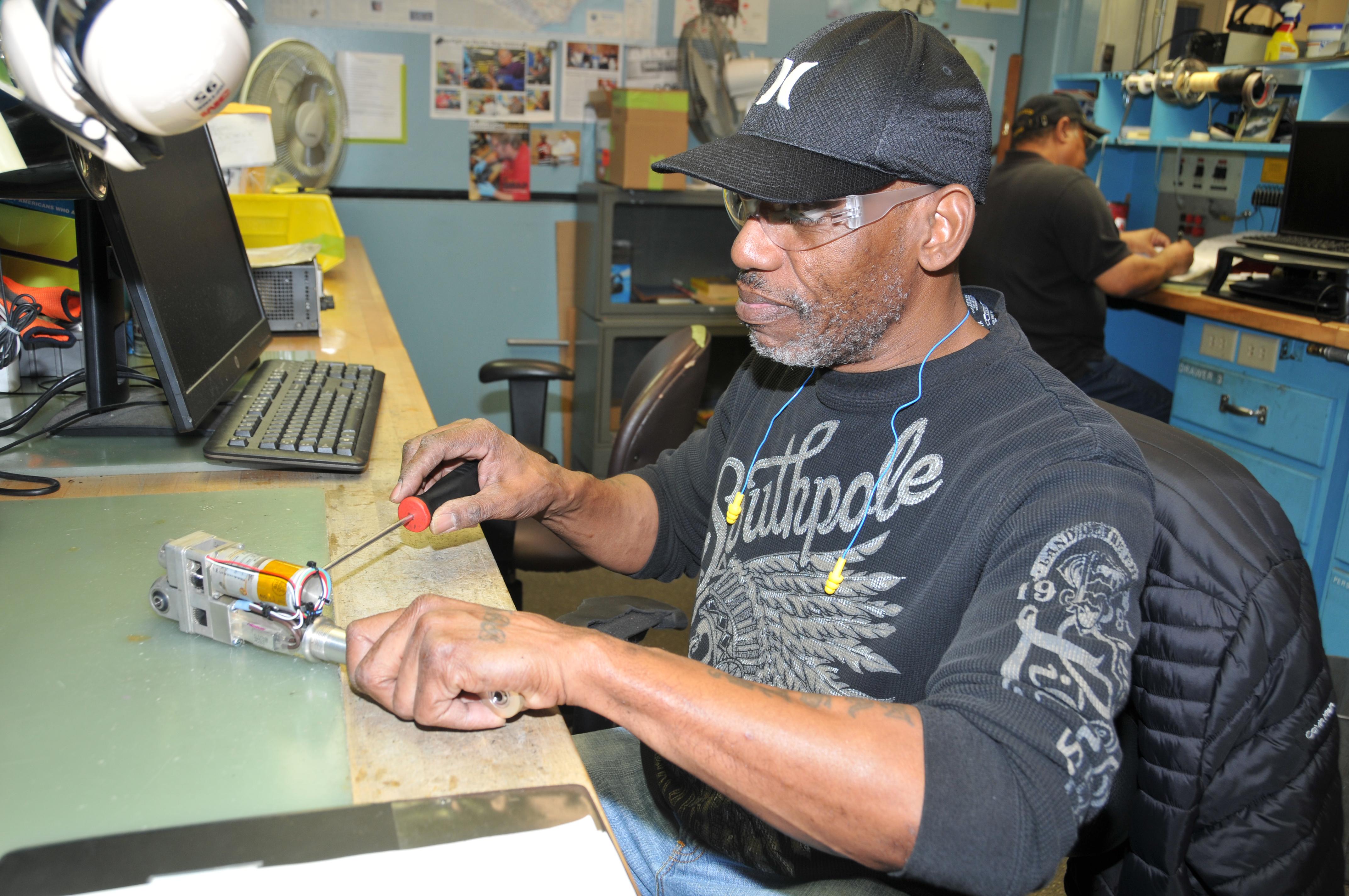
Richard P. Boyd, an electrical equipment repairer at Fleet Readiness Center East, works on the motor for an H-53 tail skid actuator. FRCE aircraft maintenance professionals and engineers worked together to develop technical instructions for repairing the motor, which previously would be scrapped and replaced with a new component if it stopped functioning. This new procedure allowed FRCE’s Components Branch to produce, test and certify enough motors to reduce the backlog that built up while waiting on new motors from the vendor.
Teamwork, ingenuity and hard work help FRCE overcome production challenges
Improving readiness of the Navy and Marine Corps’ heavy lift helicopter fleet is a top priority at Fleet Readiness Center East, and the H-53 component repair line has implemented innovative solutions to reduce production barriers.
An organizational realignment, ingenuity and collaboration between FRCE’s aviation maintenance professionals and engineers is addressing supply chain shortfalls for critical components.
In October 2018, FRCE underwent major restructure. The organization transitioned to a mission aligned organization in an effort to realign resources and skills, delegate and empower the workforce and allow decision making to occur at lower levels. For the H-53 component shop, this equated to an increase in communication and problem solving to overcome production challenges.
“MAO literally brought all the team players together,” said Lenny Domitrovits, Components Division director. “We now have aviation maintenance professionals, engineers, and Defense Logistics Agency personnel working together to remove barriers to production.”
Three high-priority fleet components had supply chain issues, including the H-53 tail skid actuator, the H-53 main engine starter, and the H-53 main engine fuel control.
The first is the H-53 tail skid actuator, which raises and lowers the tail skid. The component line was faced with a shortage of motors needed to repair the actuator. DLA immediately started working on awarding the contract to expedite the delivery of the item. The problem was the time it would take for the vendor to deliver would result in an ever-increasing backlog.
“The solution came from one of our aviation maintenance professionals,” said William Wilkinson, Components Branch head. “He said he could repair the motor. We normally replace the motor with a new one, and repairing it was not part of our normal workload.”
Working closely with the engineering team/department, the maintainer was able to repair the motor using technical engineering instructions provided by engineering. The motor was disassembled, reworked, certified and made fully functional—a first with this type of motor.
“Instead of waiting for the part that would have taken weeks if not months to get, we were able to repair them in house,” Wilkinson said.
Another innovative solution involved FRCE coordinating with Davis-Monthan Air Force Base in Tucson, Arizona, Naval Supply Systems Command, and the H-53 Program Office to see if there were any like motors available. Davis-Monthan is the largest aircraft boneyard in the world and was able to salvage 35 motors. Each was thoroughly tested and the good motors were disassembled, reworked and made fully functional, and then installed on the actuators.
“All the back orders were removed prior to the contract being awarded,” Wilkinson said. “Not only did our maintenance professional come up with the idea to repair the motor, but individually trained others. We now have six people repairing the motors.
“Engineering helped guide him on the technical aspects of the repair and was over his shoulder during the whole process,” Wilkinson said. “If this didn’t happen, our backorders for the tail skid actuator would have probably doubled by now.”
The second component, the H-53 main engine starter, involved the time on wing, or the length of time the motor can remain on the aircraft before it needs to be routinely replaced, making demand a high priority.
“We were again faced with a critical supply chain shortage of the parts we needed,” said Scott Lee, Components Branch head. “That put us in the same situation where we had to wait for the vendor to produce and deliver critical items. The longer we have to wait the larger our backlog grows. We had to come up with a solution to still put out the much needed components.”
The component shop then looked into reusing parts from other H-53 main engine starters that passed stringent tests.
“We are only able to do this because engineering is working with us as part of the team to get those starters out,” Domitrovits said. “Otherwise we couldn’t be making the calls ourselves, because those parts would be replaced. But with engineering being able to evaluate the parts and make sure what we use is within specification, we are able to return the much needed starters to the fleet.”
The third component plagued by parts shortages is the H-53 main engine fuel control.
“It is the number one component that is impacting the fleet the most,” Lee said. “The parts must come from vendors who are certified to make all these little pieces that go into the fuel control.”
Facing critical supply chain shortfalls once again, the component shop looked at the possibility of reusing parts that passed testing from engineering to assemble reworked fuel controls. The efforts made by the aviation maintenance professionals and engineering are successful.
“In the past, the maintenance professional would test the control and if it failed would put it on the reject shelf and then grab another to work on,” Lee said. “Now, we form a team and together they troubleshoot the fuel control and are able to figure it out and get it to pass.”
“The tolerances are very tight,” Domitrovits said. “In the past, our reject rate or first-pass yield was very low. Now that we have a team troubleshooting the controls together, it has gone up considerably. Before the changes under MAO, the backlog was above 60 for the fuel controls. Now it is in the 20s.
“We’ve seen some remarkable feats in H-53 component production,” he continued. “The MAO reorganization has helped our communication and coordination. It has taken an all-hands effort, and some hard work from our folks to make it happen, but that’s why we are here. It’s our job and supporting the fleet is our priority.”