
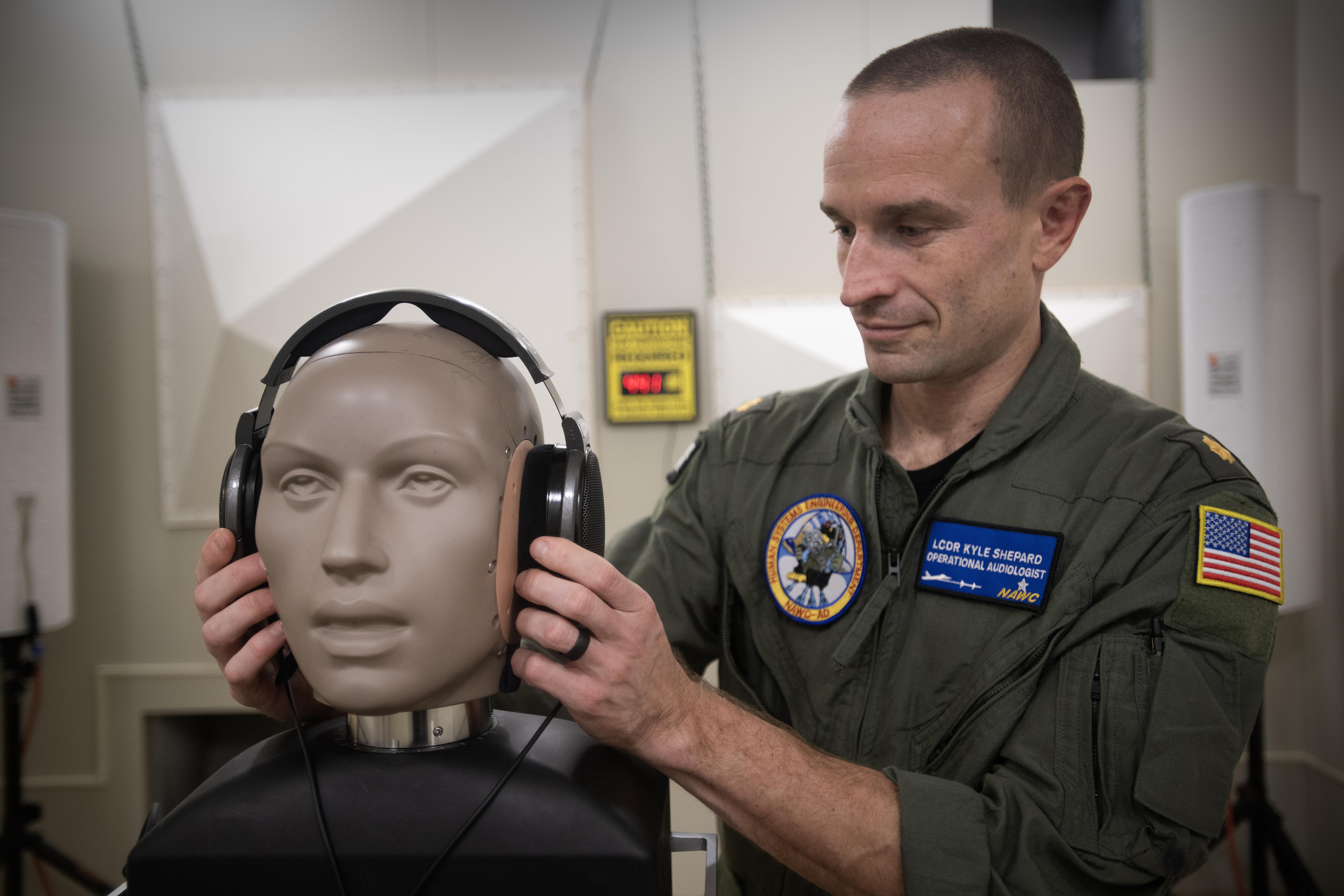
Lt. Cmdr. Kyle Shepard, resident audiologist and researcher at the Naval Air Warfare Center Aircraft Division, demonstrates audio testing in an anechoic chamber at Naval Air Station Patuxent River, Maryland. The aeromedical officer leads research that proved the Navy could use digital scanning technology and 3D printers to produce custom hearing protection in-house to address hearing damage in service members. Hearing damage affects at least 10% of the military according to data from the Navy and Marine Corps Public Health Center. (U.S. Navy photo by Todd Frantom)
The Navy's new hearing protection: made-to-measure for every sailor
Naval aviation now has a better solution to the Defense Department’s most reported injury, noise-induced hearing loss, thanks to research and development at the Naval Air Warfare Center Aircraft Division (NAWCAD).
Using digital-imaging technology, NAWCAD is developing a novel process to fit and provide service members custom hearing protection more efficiently and with less risk. The improved process is safer than today’s current process–which uses silicone injections–and will cut delivery time by at least 50%.
“Hearing damage is a readiness issue, but earns less attention because it is invisible and happens gradually over time,” said Lt. Cmdr. Kyle Shepard, NAWCAD’s resident audiologist and research lead. “Service members can compensate with hearing loss until one day they struggle to communicate from the cockpit or maintain situational awareness on the flight line or battlefield–we want to prevent that.”
Hearing damage affects at least 10% of the military according to data from the Navy and Marine Corps Public Health Center. Tinnitus and hearing loss is the U.S. military’s first and second most-reported disability. Using imaging scanners and 3D printers, the improved process would provide the opportunity to quickly fit any service member with custom hearing protection.
“Several large medical commands are already using 3D printers with biomedical materials,” said Shepard. “The missing pieces are a digital ear scanner and imaging software to make custom hearing protection in-house.”
The digital scanner features a small probe inserted into the sailor's ear to capture an image of the ear canal. Using specialized software, the image next gets converted to a 3D printer blue print. Once the image is converted, 3D printers can build custom-fitting hearing protection in minutes.
A 2006 study by NAWCAD showed that flight deck personnel typically do not insert foam earplugs correctly resulting in high risk for noise-induced hearing damage.
“We’ve seen that custom earplugs can provide improved consistency and sometimes better attenuation than standard earplugs because they conform to ear anatomy—they’re much easier to insert with less fit variability too,” said Shepard. “In addition, custom earplugs are an excellent option for aviators and ground crews using internal communication radios underneath of helmets or headsets.”
3D scanning offers a significant improvement to the Navy's current production process for custom hearing protection, which involves injecting silicone into the ear canal, waiting for it to set, and then carefully extracting the molds. This is tedious and sometimes painful for sailors with irregular ear canals, sensitive ears, or other anatomical challenges. Manufacturers can then take weeks to months to receive, produce and return the earplugs. The digital scanner is minimally invasive and makes custom hearing protection more precise, protective and comfortable because it can image deeper into an ear canal providing a better fit. Alongside 3D printers, the scanners will enable the Navy to print custom hearing protection in house.
Shepard and the team of engineers at NAWCAD have nearly completed a training program to certify users for the 3D scanner, which will make the fitting process available to most medical and safety professionals including flight physicians, safety officers and corpsmen.
Partner services including the Army and Air Force are already interested in scaling custom hearing protection.
Shepard and NAWCAD’s aeromedical engineers are ready to support any command interested in getting in touch to see how they can start offering custom hearing protection to their warfighters today.
“Let’s start getting after defense’s most reported injury,” said Shepard. “Reach out to me so we can get these scanners and training out there and expand the care our service members need.”
Interested commands should reach out to Lt. Cmdr. Kyle Shepard, NAWCAD’s head of Helmet Systems and Auditory Performance, at [email protected].
The Naval Air Warfare Center Aircraft Division employs more than 17,000 military, civilian and contract personnel. It operates test ranges, laboratories and aircraft in support of test, evaluation, research, development and sustainment of everything flown by the Navy and Marine Corps. Based in Patuxent River, Maryland, the command also has major sites in St. Inigoes, Maryland, Lakehurst, New Jersey, and Orlando, Florida.
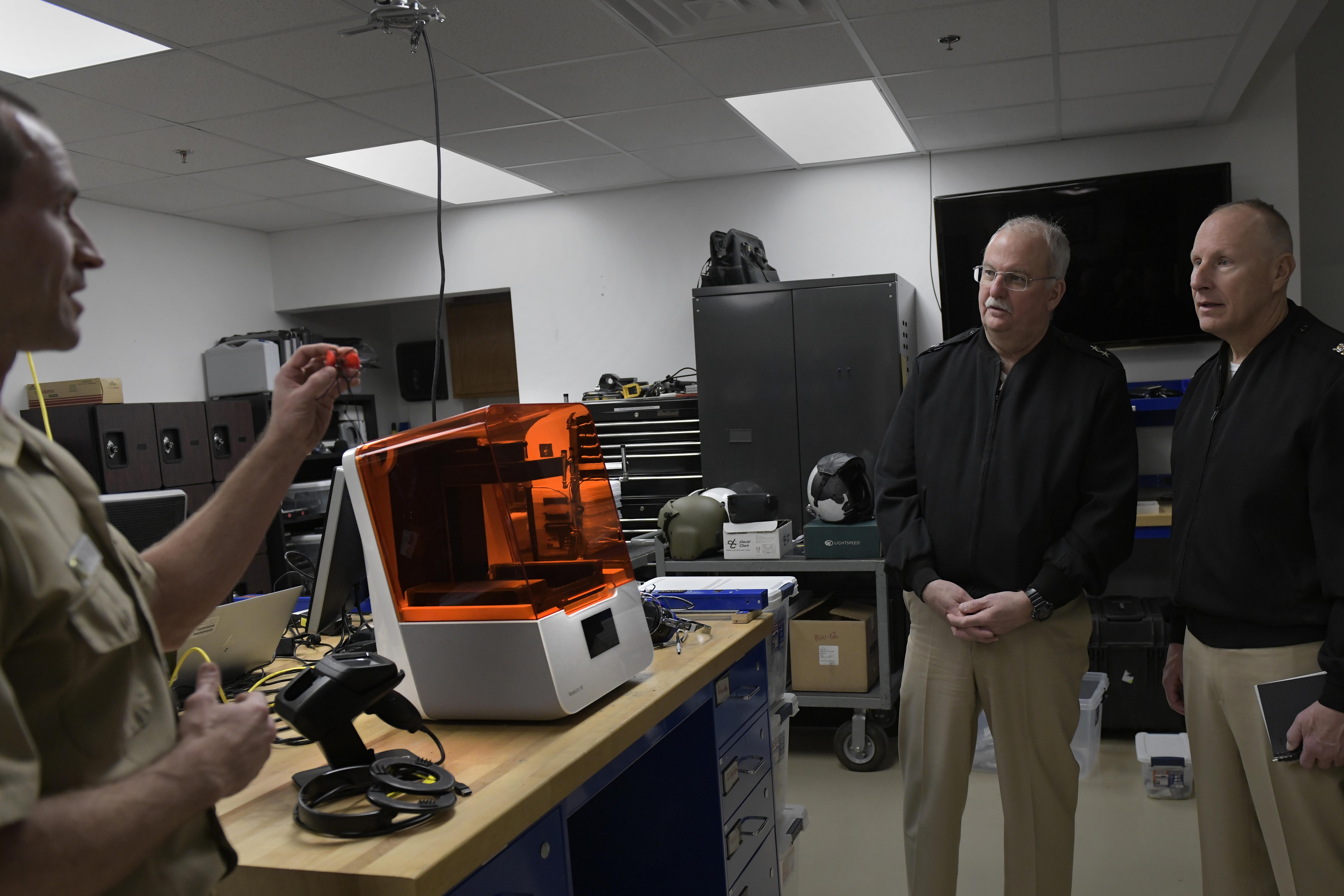
Lt. Cmdr. Kyle Shepard, resident audiologist and researcher at the Naval Air Warfare Center Aircraft Division, describes a simple process for the Navy to print custom ear plugs for its sailors using a digital ear scanner and 3D printer to Navy Surgeon General Rear Adm. Bruce Gillingham at Naval Air Station Patuxent River, Maryland. Noise induced hearing damage is the Department of Defense’s most reported injury. Shepard’s research validated the Navy could eventually fit any sailor for custom hearing protection the day they fit for their first uniform. (U.S. Navy photo by Todd Frantom)