

Participants from across the international electronic warfare community explore static displays of current and historic EW aircraft on display during the 48thAnnual Collaborative Electronic Warfare Symposium held April 2-4 in Point Mugu, California. (U.S. Navy photo by Kimberly Brown)
NAWCWD co-sponsors 48th Annual Collaborative EW Symposium
Naval Air Warfare Center Weapons Division hosted more than 650 industry and government electronic warfare leaders from the United States for the 48th Annual Collaborative Electronic Warfare Symposium held April 2-4 at Naval Base Ventura County, Point Mugu, California.
The annual symposium, hosted by NAWCWD under a co-sponsorship agreement with the Association of Old Crows, focuses on collaboration in the world of electronic warfare. Briefs are held at the classified level, allowing attendees to have more in-depth discussions than they could have in a regular meeting environment.
"This was once again a great opportunity for professionals across the entire EW community – military, government civilian, industry – to get together, hear interesting presentations and see firsthand EW capabilities in the various NAWCWD Point Mugu labs,” said John Dailey, president of the Point Mugu Association of Old Crows chapter.
Key leaders from the U.S. Navy, the U.S. Marine Corps, the Royal Australian Air Force, and the Office of the Secretary of Defense joined academic and industry leaders at Naval Base Ventura County Point Mugu, California, the home of NAWCWD’s electronic warfare capabilities, for the three-day event.
“Without a venue like this, a lot of these other people wouldn’t get together,” said Brian Ziegler, the symposium’s conference chair. “The symposium brings people out of the woodwork from government and industry to learn and collaborate together.”
Ziegler also noted that the event allows leaders in the field to learn about what other teams are doing. Work they may be able to help with or benefit from, but weren’t aware of previously.
“It’s all these little things that are kind of intangible but are enabled through this collaborative approach,” he said.
This year’s event featured keynote addresses by U.S. Navy Rear Adm. Steve Parode, director of the Warfare Integration Directorate for the Office of the Chief of Naval Operations; Dr. William G. Conley, director for Electronic Warfare for the Office of the Undersecretary of Defense, Acquisition and Sustainment; and Air Commodore Terry Van Haren, Royal Australian Air Force Washington attaché.
“Having our Australian counterparts here again this year was so important,” said Brian Ziegler, the symposium’s conference chair. “Our collaboration and continuing partnership with our Australian counterparts is only going to continue to grow.”
In addition to keynote addresses, several focused discussion sessions allowed participants a more interactive format to explore better ways to collaborate in the field of electronic warfare. Topics included electronic warfare enablers, collaborative electronic attack, and the warfighter perspective.
Attendees also toured electronic warfare laboratories and static displays, including the U.S. Navy’s last EA-6B Prowler, which was replaced by the EA-18G Growler as the Navy’s premier electronic attack aircraft. The Growler on display was from the Naval Aviation Warfighting Development Center. Also on display was an MH-60R from the “Scorpions” of Helicopter Maritime Strike Squadron 49, an E-2C Hawkeye from the “Sun Kings” of Carrier Airborne Early Warning Squadron 116, and an MQ-8B Fire Scout from Vertical Takeoff Unmanned Aerial Vehicle Maintenance Detachment Point Mugu.
For more information about NAWCWD, visit www.navair.navy.mil/nawcwd.
For more information about the Association of Old Crows, visit www.crows.org.
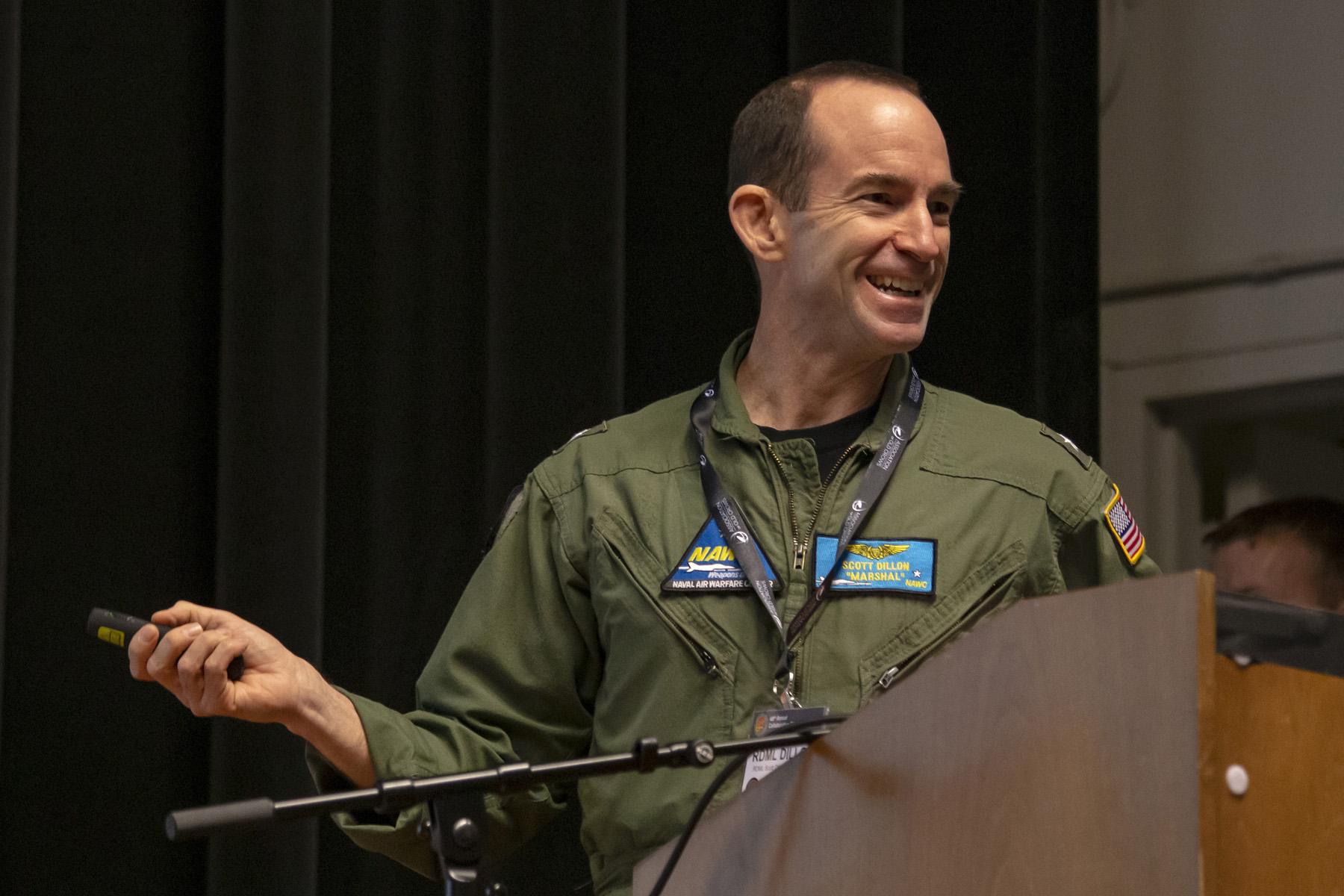
Rear Adm. Scott Dillon weclomes guests to the 48th Annual Collaborative Electronic Warfare Symposium held April 2-4 in Point Mugu, California. (U.S. Navy photo by Kimberly Brown)