NAWCTSD's Mobile NEST Expands Navy Training Capabilities
Imagine a military where warfighters can train anywhere on a submarine, whether in the crew’s mess, the engine room or other onboard spaces. The Naval Air Warfare Center Training Systems Division (NAWCTSD) is making this vision a reality with the Multipurpose Reconfigurable Training System 3-Dimensional® (MRTS 3D®) Lab's new capability: the Mobile -Navy Enhanced Simulation for Training (Mobile-NEST).
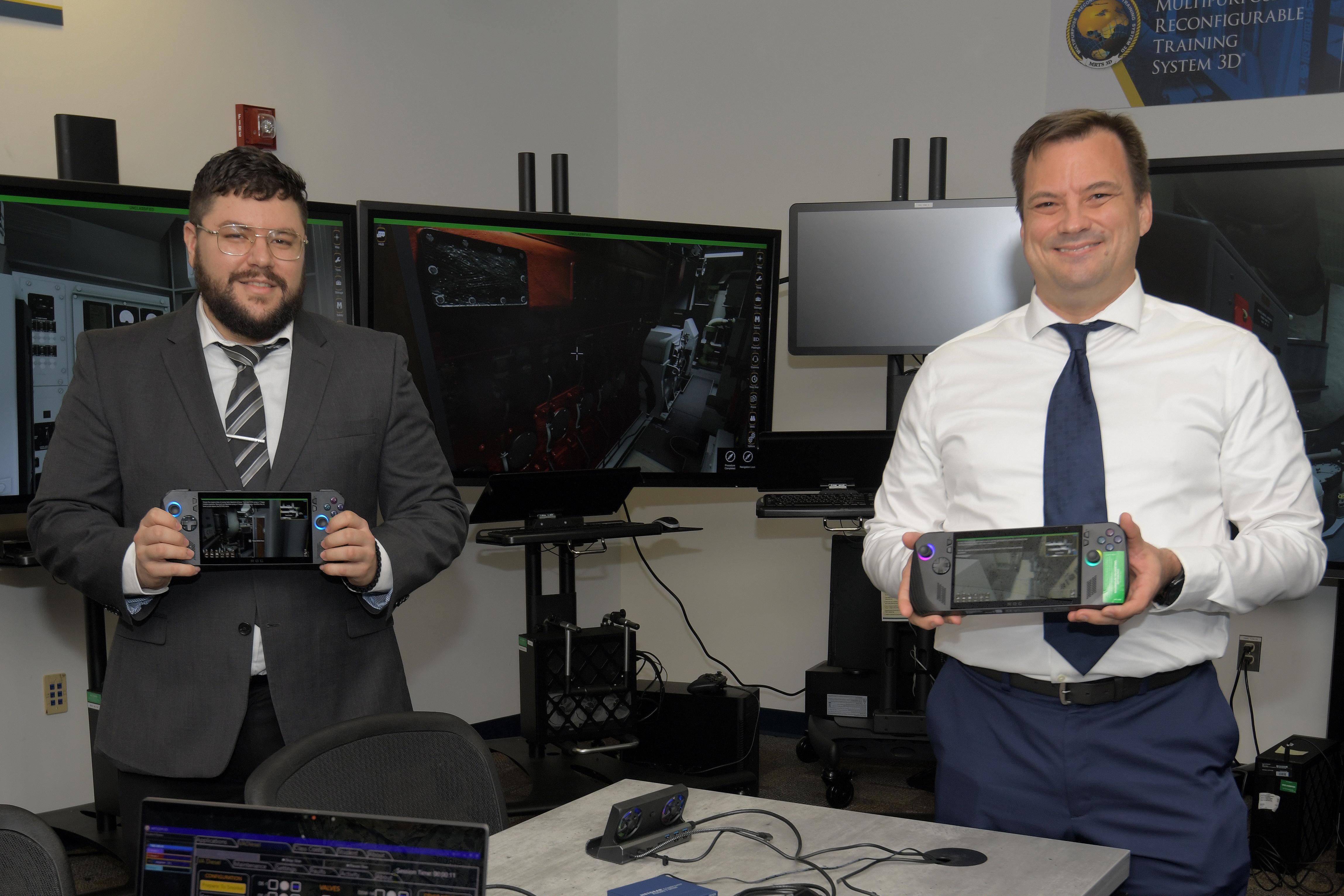
Daniel Beran, MRTS 3D Lead System Engineer and Innovation Lead for Undersea Training, identified a critical training gap—there are no full training systems available aboard submarines while underway. He shared how he and his colleagues Miguel Fortuno, Andre Azevedo, Jorge Aguilar, Chief Petty Officer Randall Shrode and NAWCTSD partners, addressed the issue by developing the Mobile-NEST, a subset of the MRTS 3D Training Suite, that will extend training from traditional schoolhouses to the fleet, ensuring that sailors remain prepared, regardless of their location.
The goal of this project is to integrate training systems directly onto submarines. “If it can fit on a submarine, it can fit on any boat,” Beran said, “our initial objective is to obtain the requirement to incorporate Mobile-NEST into current schoolhouses while showcasing the value of these systems aboard operational vessels.” This proof-of-concept project demonstrates how handheld gaming devices can enhance training retention while maintaining cybersecurity controls.
Before arriving at the concept of using gaming devices, Beran explored several creative solutions. Initially, Undersea Deputy Director Kirk Roudabush, MRTS 3D Lead Program Manager Todd Estes and the Team Orlando Tech Grove facilitated a connection between MRTS 3D and a small business technology company. Together, they developed a Virtual Reality (VR) prototype under a Limited Partnership Cooperative Research and Development Agreement (LP-CRADA) in 2023.
As part of this effort, the small business integrated the MRTS 3D Los Angeles Class Submarine Emergency Diesel Generator training application into a VR headset. This demonstration allowed a team of sailors to train in a confined space, such as the crew’s mess, using a minimal physical footprint.
The overwhelmingly positive feedback from fleet training leadership led to an Other Transaction Agreement (OTA) in 2024 with the small business. Later that same year, the introduction of commercially available handheld PC gaming controller presented an even more effective training solution than the VR headset. Recognizing its potential, the team pivoted towards using handheld gaming devices for Mobile-NEST, ultimately enhancing training flexibility and accessibility.
“The handheld gaming device turned out to be the better solution for achieving our training goals because it mitigated many of the cybersecurity concerns, we faced with the VR headset,” Beran explained.
Because the VR headset prototype transmitted Bluetooth and Wi-Fi signals, it raised security concerns related to cyber information assurance. In contrast, switching to the handheld PC controller for the Mobile-NEST proof-of-concept allowed the system to better align with Interim Authority to Test (IATT) requirements.
The handheld device operates on Windows 11, the same software used across all Navy training devices. By leveraging an already cybersecure baseline, the Mobile-NEST team gained confidence that their system could be safely deployed aboard naval vessels with minimal cybersecurity risk.
The Mobile-NEST operates both as a stand-alone or network, meaning it can be used in a networked classroom environment or individually in a completely untethered mode. With Mobile-NEST, Sailors can train on operating or maintaining the diesel engine while standing next to it, reinforcing hands-on learning. A key advantage of this system is its ability to help minimize mistakes. If a Sailor is underway and has not performed a particular procedure in some time, they can sit in crews mess, use the Mobile-NEST to refresh their knowledge and then immediately apply what they have reviewed.
Additionally, a group of Sailors can train together on board by connecting their handheld devices to the instructor’s network, allowing them to learn in a structured manner—just as they would in a classroom setting. The instructor can also connect their computer to the crew’s mess television aboard submarines, walking students through training scenarios as they would in a traditional schoolhouse.
Because space is highly valuable on a submarine, training is often limited to one or two students at a time while underway. However, Mobile-NEST expands training capacity, allowing multiple Sailors to train simultaneously without disrupting operations.
Furthermore, while Sailors cannot physically disassemble the diesel engine during training at sea, Mobile-NEST provides a realistic, hands-on learning experience with no impact on the boat’s functionality. By enabling immediate application of knowledge, Mobile-NEST enhances learning retention and gives Sailors more flexibility in their training.
The MRTS 3D training applications are just the beginning. Beran is enthusiastic about the potential of Mobile-NEST to expand training capabilities for Sailors beyond MRTS 3D. “This capability isn’t just limited to MRTS 3D. It can be utilized with almost any Windows 11-based training system,” Beran explained. The team has already demonstrated the Mobile-NEST’s effectiveness to Type Commands (TYCOMs) in San Diego, receiving high praise from leadership.
Mobile-NEST is proving to be a game-changer for submarine training, providing Sailors with flexible, realistic, and effective hands-on learning tools. With increasing support from leadership and trainees alike, the future of Navy training is evolving, ensuring that warfighters are always prepared, no matter where they are.
The latest demonstration at Kings Bay schoolhouse on March 14, 2025, further confirmed the fleet’s excitement for this innovation. The widespread praise for Mobile-NEST is fueling momentum toward an official Naval training requirement, bringing the vision of training aboard all submarines closer to reality. A future where training is no longer limited by physical constraints is on the horizon.
“This is the only feasible way to provide a realistic simulation of all manner of casualties. In an effort to prepare our military for combat, they need this level of training,” Said Lt. Cmdr. Jacob L Christiansen, Trident Training Facility Kings Bay (TTFKB) Engineering Director. “I recommend all physical trainers convert to this fidelity of training. We want better engineers, and this is a giant leap. I highly encourage NAVSEA 08 to bring this online for their training.”
“This system would be fantastic for onboard training for divisions without an established OBT program,” said Jolley Gowipy, Submarine Missile Technician. “The handhelds directly relate to the younger generations of operators and technicians, allowing them to continuously train and develop into 21st-century warfighters aboard our nation’s submarines. I highly recommend continuing this effort and expanding its functionality across all career and rating fields.”
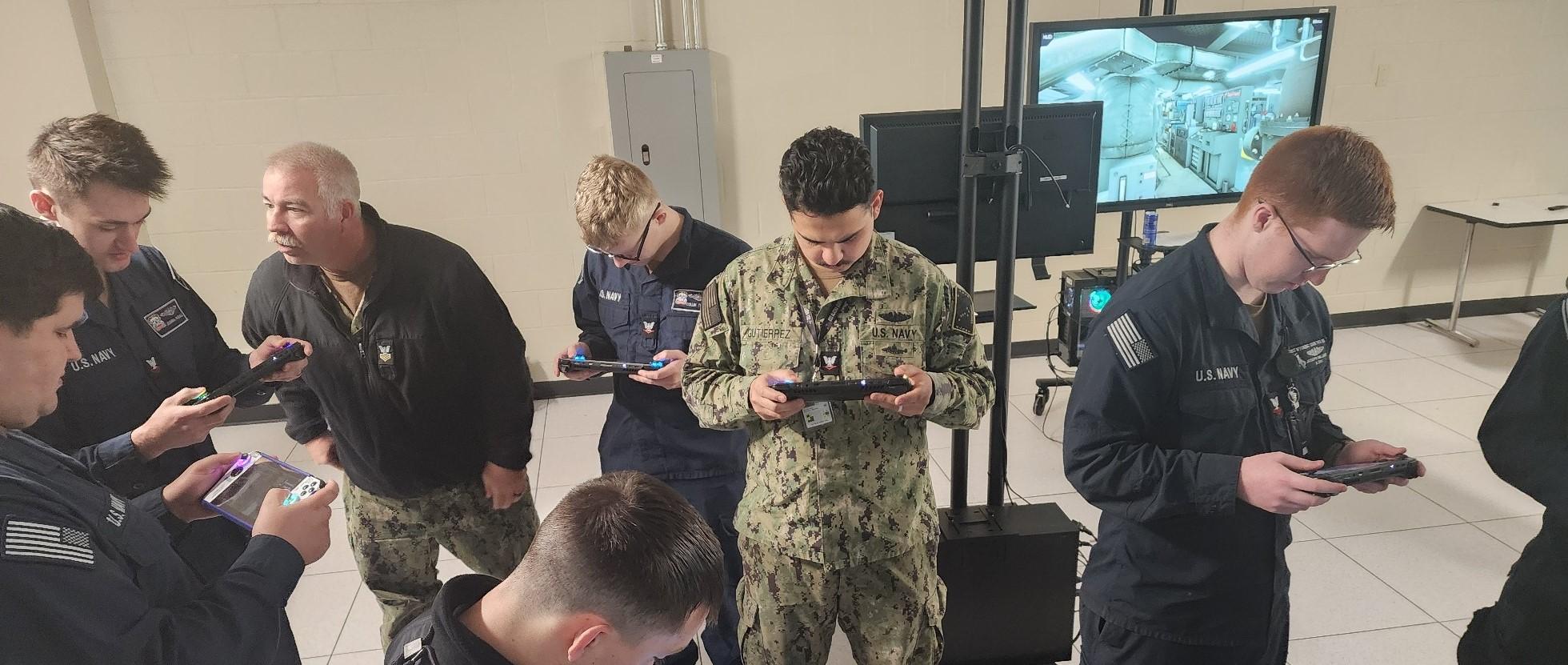
Trainees at the Trident Training Facility Kings Bay (TTFKB) utilize the Mobile Navy Enhanced Simulation for Training (Mobile-NEST). The Mobile-NEST system was adapted to a mobile gaming device to increase portability and overall function. (U.S. Navy photo)