
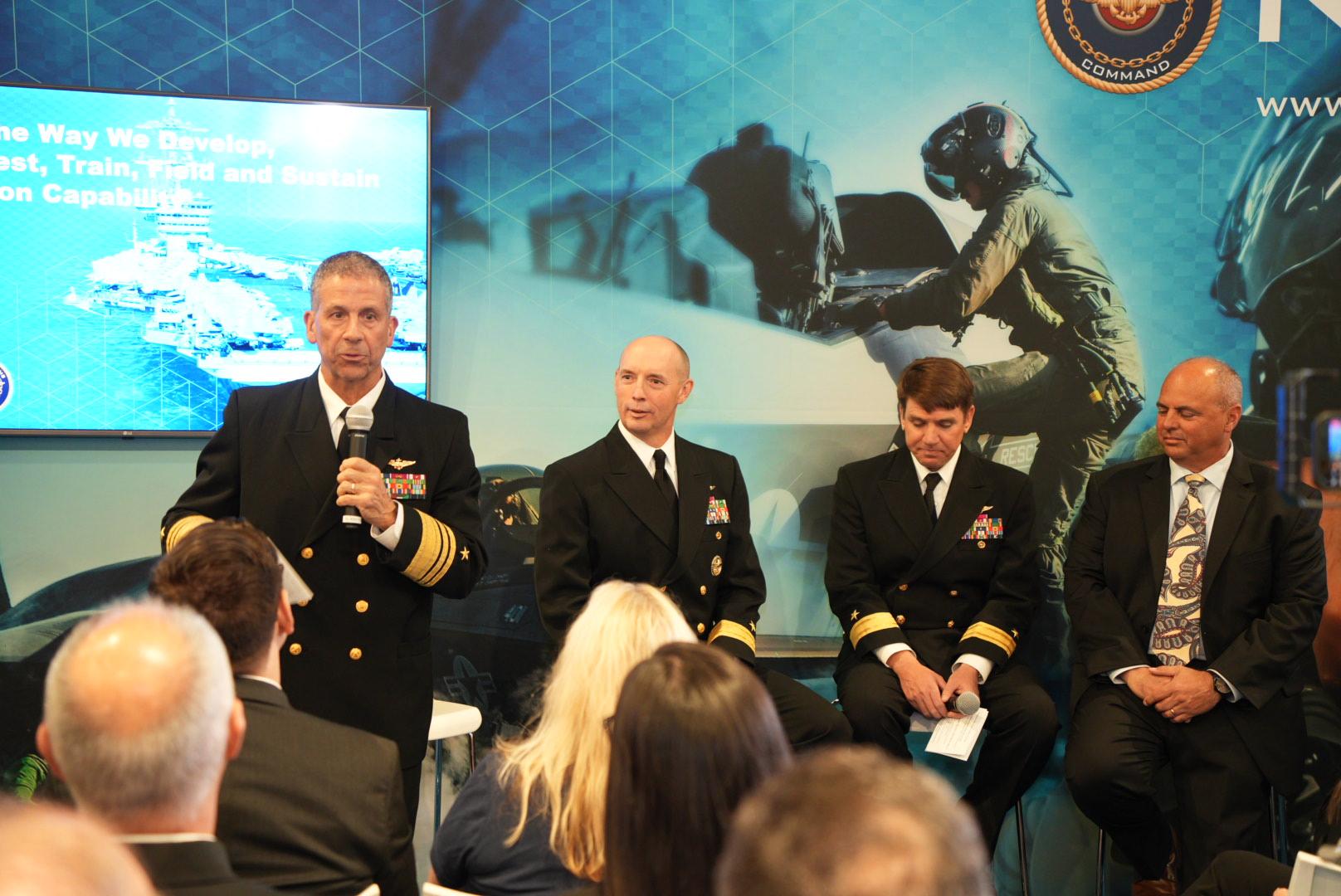
Members of Naval Air Systems Command leadership present the “Advancing the Way We Develop, Integrate, Test, Train, Field and Sustain Naval Aviation Capability" panel at the Sea-Air-Space Expo 2024. From left, NAVAIR Commander Vice Admiral Carl Chebi; Rear Admiral Joe Hornbuckle, Commander, Fleet Readiness Centers; Rear Admiral John Dougherty, Commander, Naval Air Warfare Center Aircraft Division (NAWCAD); and Dan Carreño, executive director of Naval Air Warfare Center Weapons Division (NAWCWD).
Leadership, Training Advancements, Weapons Development Take Priority at Day Two of Sea-Air-Space Expo 2024
Naval Air Systems Command (NAVAIR) leadership took the stage Tuesday morning at the 2024 Sea-Air-Space Expo to discuss how NAVAIR is “Advancing the Way We Develop, Integrate, Test, Train, Field and Sustain Naval Aviation Capability.”
The panel was moderated by NAVAIR Commander Vice Admiral Carl Chebi. Joining Chebi were Rear Admiral Joe Hornbuckle, Commander, Fleet Readiness Centers; Rear Admiral John Dougherty, Commander, Naval Air Warfare Center Aircraft Division (NAWCAD); and Dan Carreño, executive director of Naval Air Warfare Center Weapons Division (NAWCWD).
After presenting a video featuring many of the platforms and systems developed and maintained by NAVAIR program offices, Chebi introduced the panel and set the table for an open discussion.
Touching on recent Commander, Naval Air Forces Vice Admiral Daniel Cheever’s North Star targets focusing on zero loss of aircraft, zero loss of life and zero permanent disability, Dougherty said the focus on safety has taken a front seat.
“We’re all getting serious about safety; it's critically important, Dougherty said. “The first thing is all about the trust and confidence of the men and women that operate these aircraft. The other element of safety that we're focusing on is readiness. And safety costs us sometimes over a billion dollars a year or so. As we look at our performance and safety year over year, we see high variability in our performance. So that makes it ripe for us to use some of these problem-solving tools that we've been using in the Navy to get after driving the outcomes that we need in safety.”
Carreño touched on supply chain demands and keeping up to speed on weapons development.
“A couple of years ago, we kind of talked about what's plaguing weapons—they take too long and they cost too much. By the time they're fielded, the relevance isn't exactly where we needed that capability. It's not as effective as once planned,” he said.
Carreño said by examining and adopting “Get Real, Get Better” approaches to weapons development, NAWCWD is examining areas for improvement, including urging partners to stay on schedule by setting a timeline and sticking to it while identifying and addressing shortfalls in the process.
Hornbuckle said the Fleet Readiness Centers, commonly referred to as “depots,” are looking ahead by recognizing sustainment needs that will be needed in the near future and preparing to implement them.
“There are four or five programs in the next decade that are going to need advanced composite repair [that’s not currently available],” Hornbuckle said. “We’ll work with the [program executive offices] and the programs to come up with a coherent strategy for naval aviation and where to put that capability
and all our other capabilities. … We know not only what we’re investing in organically [at the FRCs], but what we’re doing with our industry partners to ensure we have the ability to surge, that we have resiliency in our system and that we can perform economically.”
Chebi opened up the discussion to questions from the audience, which varied from lessons learned from the F-35 Lightning II development, maintaining safety standards while keeping costs down and the use of additive manufacturing. In response to a question regarding the high price tag of the F-35 development, Chebi said programs are giving sustainment a closer look.
“If I were to look at the cost structure of any program, we spend a lot of time focused on the development aspects. From a cost perspective, the development aspect of any program in the lifecycle is 5 percent of the requirements. Procurement is the next biggest one we focus on at 15 percent. To sustain the platform for its lifecycle is 80 percent of the cost,” Chebi said. “So, if I look at the $1.7 trillion cost for the F-35, most of that is in sustainment. The biggest lesson learned is how do I invest in the necessary decisions now to be able to support my platforms going forward and make it an affordable platform? How do we design it differently? How do we test it differently?”
A question regarding the recent grounding and eventual clearance of the CMV-22 Osprey prompted Dougherty to again address the focus on safety.
“I can tell you that we're dead serious about making sure that platform is ready to return to its full mission in a safe manner, and there are engineering things that we're going to get after to make sure that is the case,” he said.
“If we double-down on safety, but do the exact same thing, nothing will change,” Chebi said. “We have had a significant amount of discovery while doing investigations on multiple programs and see that we need to change what we're doing to actually achieve [the right] outcome.”
NAWCAD Executive Director Steve Cricchi and NAWCAD Joint Simulation Environment (JSE) Director Blaine Summers hosted the next panel in the afternoon highlighting the JSE, the DOD’s premier digital range where pilots are put to the test in extreme limits and fly wartime scenarios too dangerous to replicate on open-air ranges.
Cricchi explained the vast partnerships NAWCAD has across the Navy and how it works within that ecosystem to develop and test weapons and aircraft and deliver them to the fleet. He said that those partnerships are crucial to NAWCAD’s mission, particularly in developing something as advanced and complex as the JSE.
“The JSE did not create itself,” Cricchi said. “It is a capability that was created by organic Navy engineers in partnership with industry and the talent that it takes to deliver… that is deep technical talent. We’re
constantly working with our educational outreach partners all the way from elementary school through secondary education to create pipelines of talent through the Warfare Center, so that we can create capabilities like the Joint Simulation Environment.”
The JSE was built by NAWCAD for use across the Department of Defense, and is a hyper-realistic simulation environment made up of hardware including cockpits, domed simulators with 4K projectors and software to form a high-fidelity digital range used to train tactical pilots, and test new defense technology in near-exact virtual battlespaces. The idea to build the simulator came out of a need to fully test F-35 capabilities and pilots.
Summers said the idea to create the JSE was born out of the realization 15 years ago that realistic testing of F-35 capabilities could not be performed accurately or efficiently in open-air test ranges, and the idea to switch to digital modeling and simulation was born. The challenge was replicating real-world conditions in a digital environment.
“We need a near perfect representation of the F-35, a near perfect representation of a threat and near perfect representation of the physics-based environment that we would operate in as a warfighting force,” Summers said. “In that pursuit of a near perfect digital range, what has fallen out is this government-owned ecosystem where we can fully evaluate multi-platform, multi-domain integrated warfighting capabilities. While we were pursuing near perfection for operational test purposes, what is falling out is a world class training environment. It [produces] a near perfect representation of the real world to hone warfighter tactics in a fifth or sixth generation fight where our adversary is capable.”
Summers said the JSE houses enclosed F-35 cockpits that are fully detailed down to every switch and knob, and uses software that fully represents how an F-35 reacts in flight and in battle. The JSE can pit any pilot in a realistic scenario against surface threats, fifth-generation enemy aircraft and practically any real-world threat that a pilot could face in the battlespace. The JSE, while originally created to meet F-35 needs, is currently incorporating F-22 Raptor, F/A-18 Hornet, E-2D Hawkeye and other components of the carrier air wing for training in the same challenging environment. As of last month, Summers said, the JSE has seen more than 1,000 F-35 pilots come through, leaving better prepared and more battle-tested than they would have under previous, traditional training scenarios.
Partnerships with industry are necessary to keep the software and data gleaned from the JSE moving forward, Summers said. He said there was a recent mandate from the Air Force that all Air Force platforms and weapons be integrated into the JSE. His team is also looking into the ability to deploy more simulators across the DoD, including on deployed ships.
The Naval Air Warfare Center Training Systems Division is the principal Navy center for research, development, test and evaluation, acquisition and product support of training systems, and provides coordination and training systems support for the Army, Marine Corps and Air Force. NAWCTSD Commanding Officer Capt. Tim James began his panel discussion in outlining the NAWCTSD mission.
“It’s all about making training devices, services, products, etc., and sustaining them as well as developing them,” James said.
Housed at Naval Support Activity Orlando, Florida, James said that while the base is the smallest Navy base in the world, it pushes out about $7 billion a year in contracts, “the highest economic per square foot Navy base in the world as well. It’s the most and least important base in the Navy.”
The Orlando location is crucial, James said, as it has allowed the Navy to partner with industry that are at the top of delivering “suspend your disbelief” type of technologies and experiences including Disney, EA Sports and Universal Studios. Further, within a 100-mile radius, the base is surrounded by several learning institutions—more than half a million students with most of them interested in technical fields. James said NSA Orlando is positioned in such a way to attract talent to the DoD from that tech corridor by having those partnerships.
Among the many services provided at NAWCTSD is sustainment of training systems, James said.
“We sustain pretty much every permanent Navy training system across the world. The sun never sets on TSD,” he said. “We have people in Japan or Australia or in Europe keeping any type of Navy training system up and running. We mandate a minimum of 95 percent operation availability, but we pride ourselves in always being able to stay above 98 percent… We keep all these devices up and running across about 160 sites.”
NAWCTSD also provides training/classroom services for those systems, as well as tapping into a network of PhDs to examine effects of flight such as hypoxia or motion sickness. As a way of dealing with budget crunches and to keep training systems modern, James said NAWCTSD has been looking at ways to implement artificial intelligence (AI) into reducing some of the mundane or repetitive tasking often needing extra manpower to handle.
Rounding out the day’s speakers was Carreño, again representing NAWCWD.
“We deliver integrated and interoperable warfighting capabilities through cutting-edge research, development, acquisition, test, evaluation, and sustainment to provide the warfighter the decisive advantage,” Carreño said, stating NAWCWD’s mission. “Integrated has meant a growth in complexity. And it's really that the complexity of the battlespace is just growing exponentially.”
To achieve the intended result of providing the warfighter with the greatest advantage, Carreño said partnerships with industry are important. Currently, NAWCWD has 30 active Cooperative Research and Development Agreements (CRADAs) ranging from large, small and nontraditional business partners, and academia, and began 15 new Commercial Service Agreements (CSAs) last year. He reiterated that weapons development often takes too much time and that is where industry innovations and advances come into play. He said traditionally, weapons are developed with a prime supplier and parts and software for those systems come at the speed of the supplier. To try and find faster ways, he said opening the door to non-traditional or smaller suppliers not only spurs competition, but also is mutually beneficial.
“I'm excited about the path that we're on,” he said. “The partnerships and enabling nontraditional participants into our weapons business is something that's badly needed.”
The Sea-Air-Space Exposition, taking place at the Gaylord National Resort and Convention Center at the National Harbor, Maryland, is an annual event hosted by the Navy League of the United States. SAS brings together the U.S. defense industrial base, private-sector U.S. companies, key military decision-makers, and international allies and partners for an innovative, educational and professional maritime-based event.

Naval Air Warfare Center Aircraft Division (NAWCAD) Executive Director Steve Cricchi and NAWCAD Joint Simulation Environment (JSE) Director Blaine Summers discuss how the state-of-the-art simulator is challenging F-35 Lightning II pilots by pitting them against advanced "enemies" in a virtual, realistic environment.

Naval Air Warfare Center Training Systems Division Commanding Officer Capt. Tim James details how the NAWCTSD in Orlando, Florida, is the principal Navy center for research, development, test and evaluation, acquisition and product support of training systems, and provides coordination and training systems support for the Army, Marine Corps and Air Force.

Dan Carreño, executive director of Naval Air Warfare Center Weapons Division (NAWCWD), discusses the challenges faced in deliver warfighting capabilities to the fleet.