

The Innovation Lab at Naval Air Warfare Center Weapons Division provides a collaborative space for active duty, civilians, and industry partners. The lab focuses on accelerating the development and fielding of technology to meet fleet requirements. (U.S. Navy photo by Ryan Smith)
Innovation Lab turns ideas into warfighter solutions in days, not months
When contractors quoted mechanical engineer Vincent Malpaya $2,500 per unit to manufacture a switch matrix for rocket testing, he needed ten of them. Instead of waiting months and paying tens of thousands of dollars, he built the part himself in Naval Air Warfare Center Weapons Division’s Innovation Lab for 20 cents per unit. The savings helped keep the project on track and supported the fleet’s test schedule.
For Malpaya and many others, solving problems fast is part of the job. The Innovation Lab gives them the tools and space to do it.
“I’m working on this gimbal,” Malpaya said during a recent visit, shaping his design on a computer screen.
Stories like his highlight how the Innovation Lab strengthens readiness across the command. Employees can design, build and test ideas sooner, which helps deliver capability to the warfighter faster.
NAWCWD operates two Innovation Labs, one at China Lake and one at Point Mugu. Both sites offer the same equipment and training, and employees can use either location. Shared access cuts wait times and helps teams working across both installations keep projects moving without delay.
Fast solutions for real problems
For some projects, speed is the only way to meet the mission.
In an approach called rapid prototyping, the Innovation Lab uses 3D printers, laser cutters and CNC machines to help teams build prototypes in days instead of months.
“We’re just trying to cut down a lot of lead time,” said Kevin Hughes, the Innovation Lab manager at Point Mugu.
Drew Hines, an engineer working with Range Support Aircraft, faced that challenge firsthand.
His team needed to mount new equipment on a KC-130 to support a scheduled test event in Australia, but the technical documentation was incomplete. Some dimensions were missing. Others were wrong.
Sending a flawed design to an outside machine shop would have cost thousands of dollars and weeks of time. Instead, Hines and his coworker Sam Newcomer used the lab to 3D scan the equipment, design a mounting plate and cut a prototype from plywood on the CNC machine. When the hole patterns did not line up, they made corrections for pennies.
“The flexibility to make something new, adjust it, test it, find a mistake, fix it, and still support the mission is what justifies having this place,” Hines said.
Building skills that support the mission
From saving thousands of dollars on test equipment to solving problems on tight schedules, the Innovation Lab helps NAWCWD deliver capability at the speed of relevance.
For Malpaya, the lab has already made a measurable impact. He can now print a gimbal mount for a weapons system he is supporting.
Hughes said the lab represents what he values most about working in defense.
“I’m doing something for the service, for the warfighter,” Hughes said, adding that faster solutions mean test events stay on track and capability reaches the fleet sooner.

Kevin Hughes, the Innovation Lab manager at Naval Air Warfare Center Weapons Division, demonstrates the material station of a 3D printer at the Innovation Lab. (U.S. Navy photo by Michael L. Smith)

Vincent Malpaya, mechanical engineer with the Airborne Telemetry Group, compares a 3D-printed prototype to its computer-aided design (CAD) model at the Innovation Lab. (U.S. Navy photo by Ryan Figueroa)
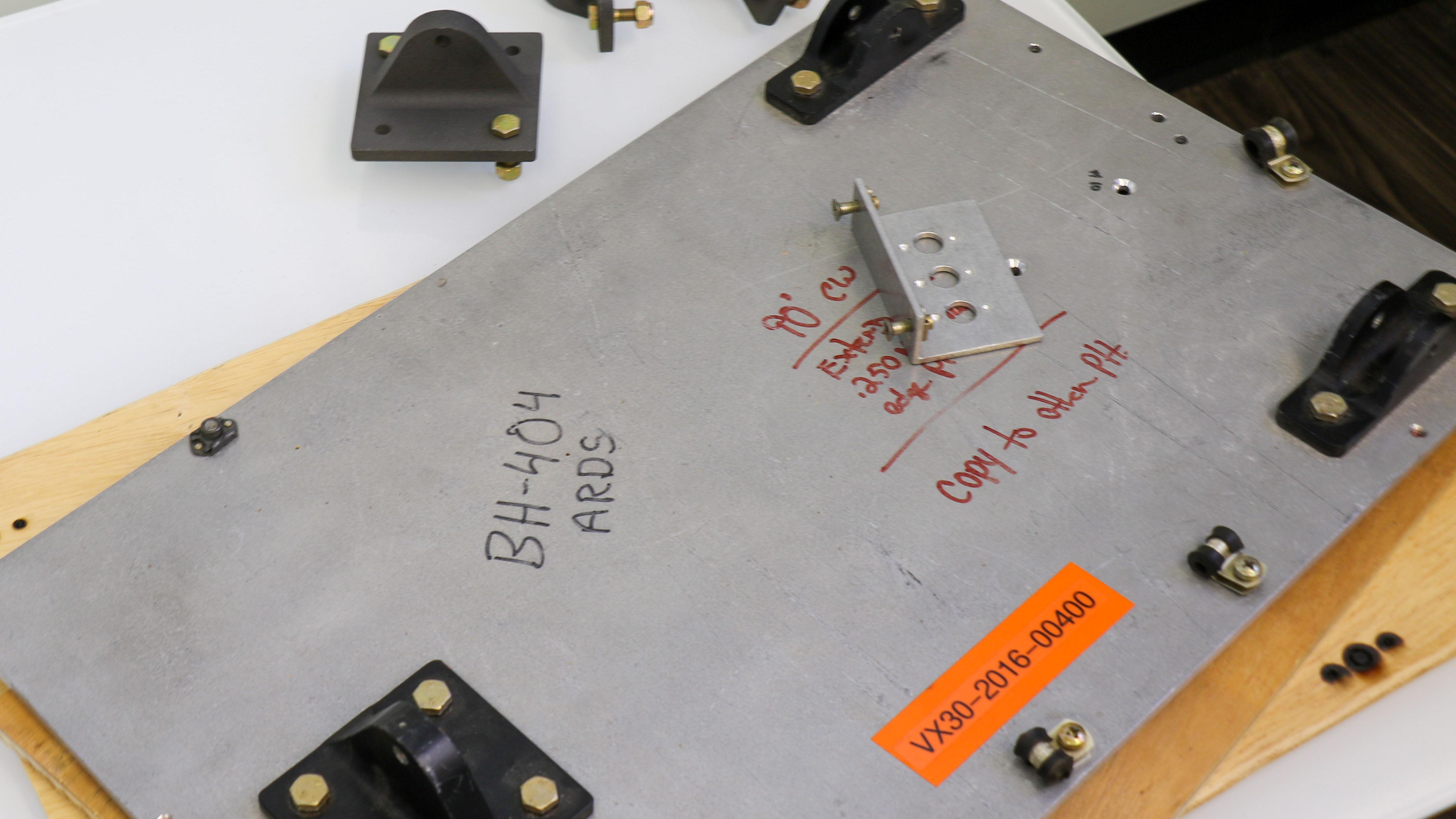
A reverse-engineered fixture for an aircraft component sits on a workbench in the Innovation Lab at Naval Air Warfare Center Weapons Division. The lab created the fixture and accompanying 3D-printed parts for Air Test and Evaluation Squadron (VX) 30 to solve a fleet maintenance issue. (U.S. Navy photo by Ryan Figueroa)