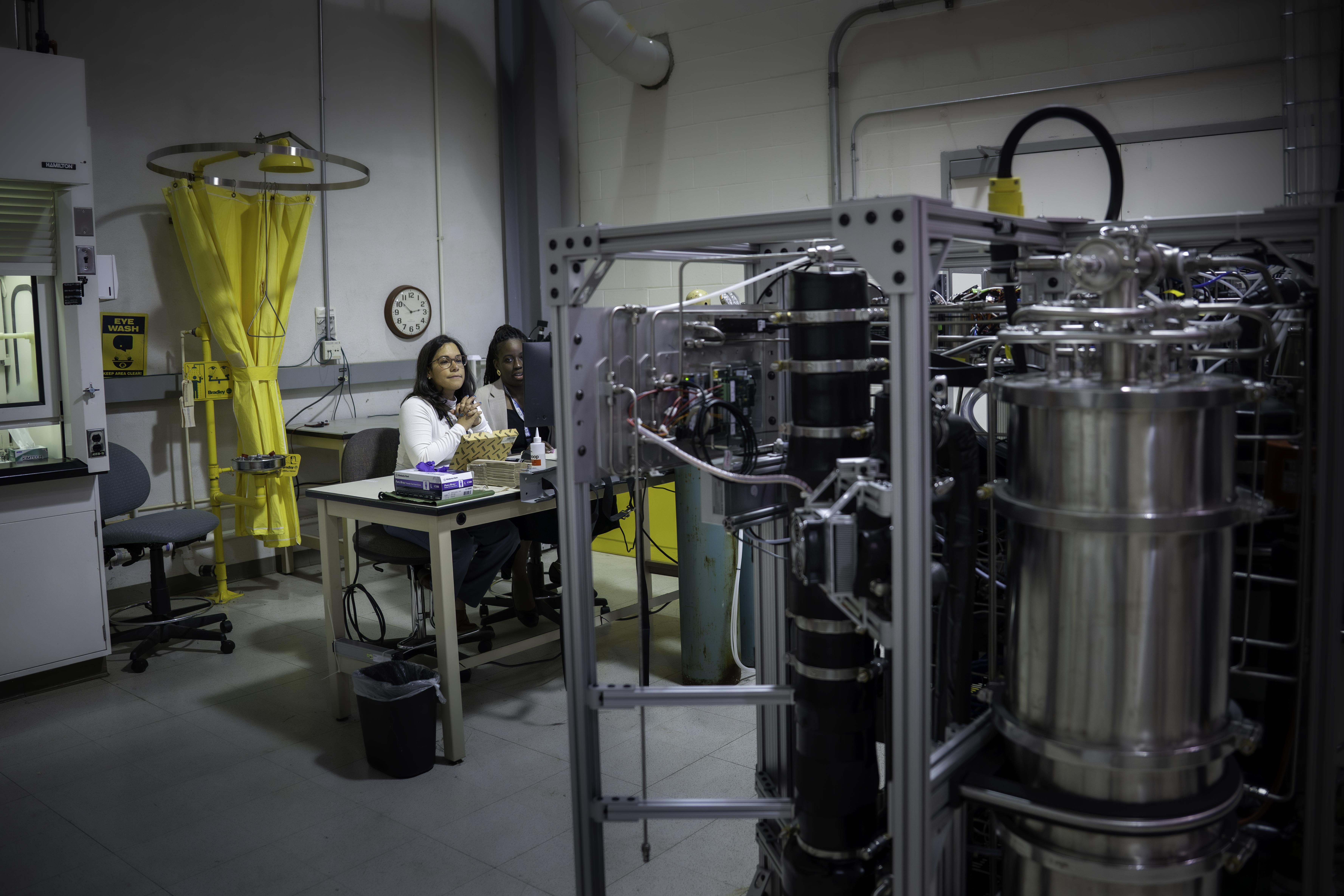
A team from the Naval Air Warfare Center Aircraft Division monitors data collected during an oxygen system contamination test to check for potential aircrew air impurities using the Navy’s new test rig called the Gaseous Injection Analyzer, or GaIA. The warfare center built the service’s singular test capability to verify modern oxygen systems effectively filter contaminants in compliance with today’s military standards in partnership with Johns Hopkins University. (U.S. Navy photo by Todd Frantom)
Aircrew safety improved with new oxygen purity test at NAWCAD
For the first time, the Navy can precisely test how well modern oxygen systems remove impurities to ensure safe air for aircrew following a successful demonstration by teams at the Naval Air Warfare Center Aircraft Division (NAWCAD).
There was previously no way to test whether oxygen systems meet the latest military standards that limit contaminants and prevent exposure-related health issues in flight.
“Pilot safety is combat readiness,” said NAWCAD Commander Rear Adm. John Dougherty IV. “Safe systems are the foundation that ensures aviators focus on the mission – not their next breath.”
NAWCAD’s scientists, chemists, and engineers built a test rig called the Gaseous Injection Analyzer (GaIA) in partnership with Johns Hopkins University. The test rig integrates advanced hardware and analytics to test air systems including On-Board Oxygen Generation Systems in jets – commonly called OBOGS – for air contaminants.
“Defense aviation’s safety standards are high, and many felt this test was impossible,” said NAWCAD Senior Chemist Dr. Leah Eller, who led GaIA’s development. “We made it possible – it’s an important step in maintaining the highest standards of safety and operational readiness.”
GaIA has two primary purposes: testing new or improved oxygen systems early during the development phase in collaboration with defense partners, and as a fleet resource supporting engineering investigations.
In 2017, the Navy prioritized addressing in-fight health effects called physiological episodes after an increase in reports by fleet pilots. Although investigations ruled out contaminant exposure as a contributing factor, the inability to quickly assess exposure risks highlighted a critical gap. NAWCAD’s GaIA ensures future oxygen systems prioritize chemical exposure prevention and gives the Navy an ability to address emerging concerns.
For technical consultations on oxygen systems or related components, contact NAWCAD’s GaIA test team lead Dr. Leah Eller at [email protected].
NAWCAD’s military, civilian, and contract personnel operate test ranges, laboratories, and aircraft in support of test, evaluation, research, development, and sustainment for all Navy and Marine Corps aviation platforms. Based in Patuxent River, Maryland, NAWCAD also has major sites in St. Inigoes, Maryland; Lakehurst, New Jersey; and Orlando, Florida.