
|
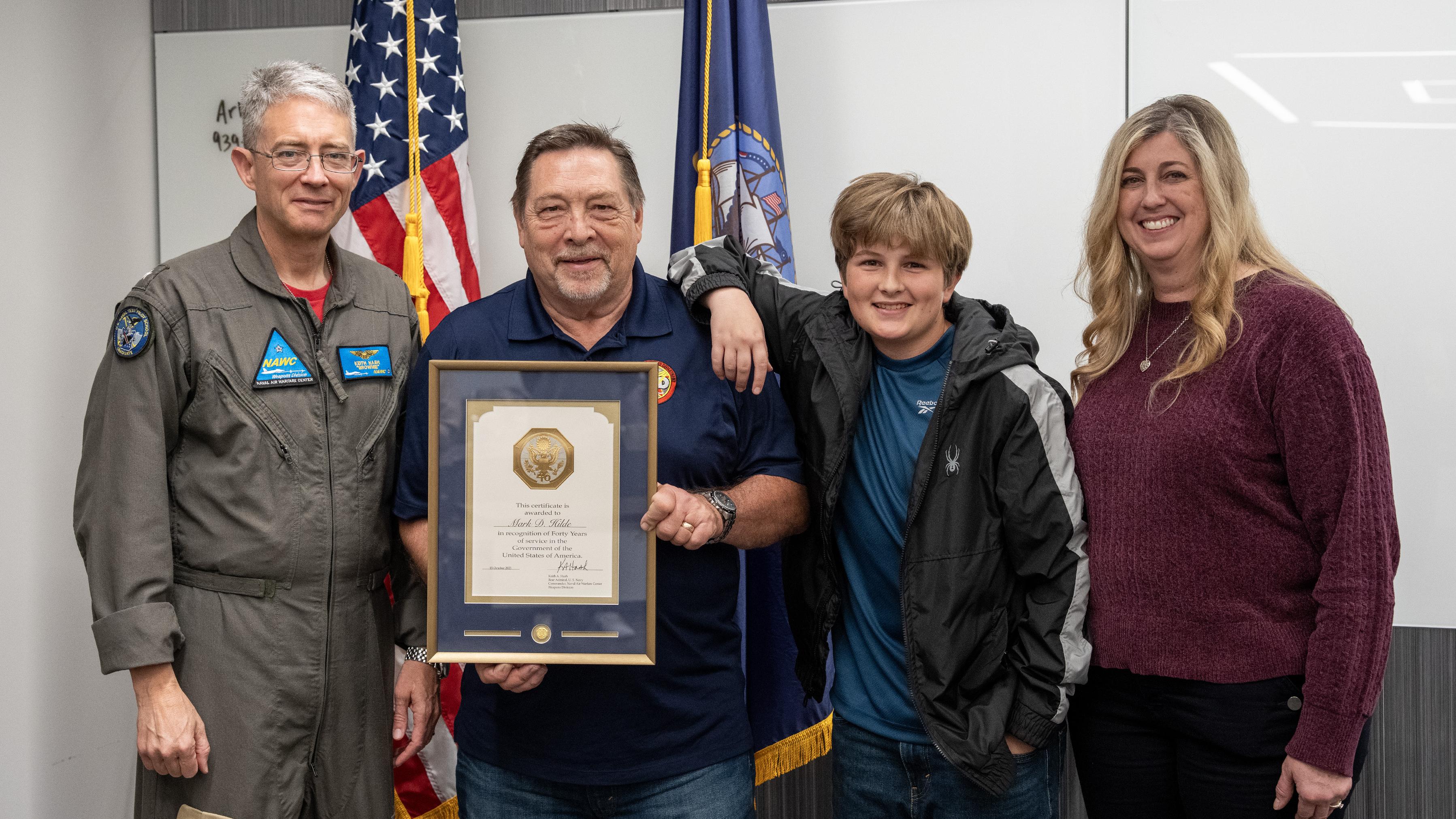
Mark Hilde, a senior software engineer at the Tactical Air Range Integration Facility, receives a 40-year length of service certificate from Rear Adm. Keith Hash, commander, Naval Air Warfare Center Weapons Division, alongside his wife, Catherine, and son, Davin, during a recognition ceremony at NAWCWD in China Lake, California. (U.S. Navy photo by Ryan Smith) |
40 years of service: The engineer who gave China Lake two weeks
Mark Hilde gave China Lake two weeks.
It was June 1985, and the temperature topped 110 degrees when he arrived in Ridgecrest. His first day brought another surprise: no desk, no office, and no one who remembered an intern was coming. After traveling halfway across the country from North Dakota for a government job he never really wanted, Hilde decided to give the Naval Weapons Center two weeks to prove itself.
That was 40 years ago.
Today, Hilde works as a senior software engineer at the Tactical Air Range Integration Facility, developing applications that give tactical training ranges what they need to prepare the warfighter. His four decades at Naval Air Warfare Center Weapons Division trace a path from software development to systems engineering to project management and back again. Along the way, he pioneered live virtual constructive simulations, stood up Link-16 systems at the North range, and led coalition exercises that built trust between allies.
That journey began with a job application he never wanted to send. Hilde enrolled in North Dakota State University’s Co-Operative Education program while pursuing his computer science degree. He applied to several major tech companies in California, but there was also an opening with the Naval Weapons Center at China Lake.
“I applied reluctantly, at the urging of the Co-Op office, as working for the government didn’t sound very exciting,” Hilde said. “I couldn’t have been more wrong.”
His first day proved challenging. No one expected him. He had no workspace and no assignments. A co-worker eventually took pity on him and arranged tours of different areas across the base.
“I saw the amazing opportunities available,” Hilde said. “I decided to stay and complete my tour.”
The co-op internship lasted only one summer. Hilde returned to North Dakota State to finish his degree, where Fargo’s winter greeted him with wind chills of 40 below zero. The 150-degree drop from the Ridgecrest heat clarified something. He wanted to go back to California.
After graduating in 1987, Hilde returned to China Lake permanently. He accepted a position with the Weapons and Tactics Analysis Center as a modeling and simulation software developer. The center operated a multiplayer wargame simulation designed to provide pilots with advanced tactical training.
Hilde participated in what was likely the first live virtual constructive event at China Lake. The technology allowed real aircraft, simulators, and computer-generated forces to train together in the same exercise. Pilots could practice complex scenarios against simulated threats while actual aircraft flew on the range, creating realistic training that would have been too dangerous or expensive to conduct with live assets alone.
Hilde spent nearly a decade at WEPTAC, refining distributed simulation technology. In 1998, he transitioned to the Range Control Center, where he provided software development support for range display systems.
In 2004, China Lake expanded its range training capabilities with the addition of Link-16, the tactical data link system that allows aircraft, ships, and ground forces to share real-time information during operations. Hilde stood up the Link-16 terminal at the North range and developed an interface to inject live range tracks into the network. Test aircraft could now train using the same tactical communications they would use in combat.
He later shifted from software development to systems integration and engineering, moving to the Weapons Engagement Office to take on the Empire Challenge and Enterprise Challenge events.
Hilde participated in Empire Challenge and Enterprise Challenge from 2004 to 2019, providing exercise and limited objective event support for the Office of the Under Secretary of Defense for Intelligence and the National Geospatial-Intelligence Agency. The exercises brought together U.S. forces and coalition partners to demonstrate new and emerging intelligence, surveillance, and reconnaissance technologies aimed at closing gaps in interoperability and standards implementation.
His responsibilities expanded over time. He integrated imagery, command and control, and mission coordination systems before eventually leading the systems engineering effort at China Lake. He later served as project manager, helping ensure complex systems worked together in realistic operational scenarios.
Separate from the exercise work, Hilde traveled to Germany in 2005 to support a system installation at U.S. European Command. In 2010, he developed web client prototypes for Central Command, delivering updated capabilities to meet operational needs.
The National Geospatial-Intelligence Agency relied on Hilde’s team to deliver critical capabilities. When requirements came in, Hilde’s response was consistent.
“NGA would come to us with requirements, and we’d do whatever it took to make it happen,” Hilde said. “We wanted them to know that you can come to China Lake and we will make it happen.”
The NGA commander running Enterprise Challenge gave Hilde a nickname that stuck: the Swiss Army Knife of Enterprise Challenge.
The comparison captured Hilde’s versatility and willingness to handle any task required to ensure mission success. When Central Command rejected a collateral damage assessment tool he developed because they disliked the interface, Hilde rewrote it on his own time. Central Command accepted and used the updated version.
“You might fail, but it doesn’t mean you’re done,” Hilde said. “Just try again.”
Isaac Graham, Tactical Air Range Integration Facility integrated product team lead, said that tenacity defines Hilde’s approach to work.
“If you want a hard worker that knows their job and just wants to work, that’s Mark,” Graham said.
Graham said Hilde influences junior team members by example.
“Mark shows the junior software engineers that you can keep making an impact no matter how long you’ve been here,” Graham said. “His example influences the whole team.”
That impact continues today, though in a role Hilde never expected to hold again. In 2024, Hilde accepted a senior software engineer position at the Tactical Air Range Integration Facility. The decision meant returning to hands-on software development after 20 years in systems engineering and project management.
“This decision turned out to be a great one,” Hilde said. “I now develop and support applications that provide tactical training for the warfighter.”
He develops software that helps Navy and Air Force training ranges work together seamlessly. The work brings his career full circle. He’s back to writing code and working with distributed simulations, much like he did in the early 1990s. The difference is the depth of experience he brings to the role.
After four decades of proving himself, Hilde remains humble about his legacy. Looking back on 40 years, he said he hopes people remember him as someone who always gave his best effort and worked as part of a team.
For someone who almost left after two weeks in 1985, that persistence has made all the difference.
“Supporting the warfighter is at the heart of what we do,” Hilde said. “I take pride in knowing that my contributions, no matter how small, play a role in their success.”