
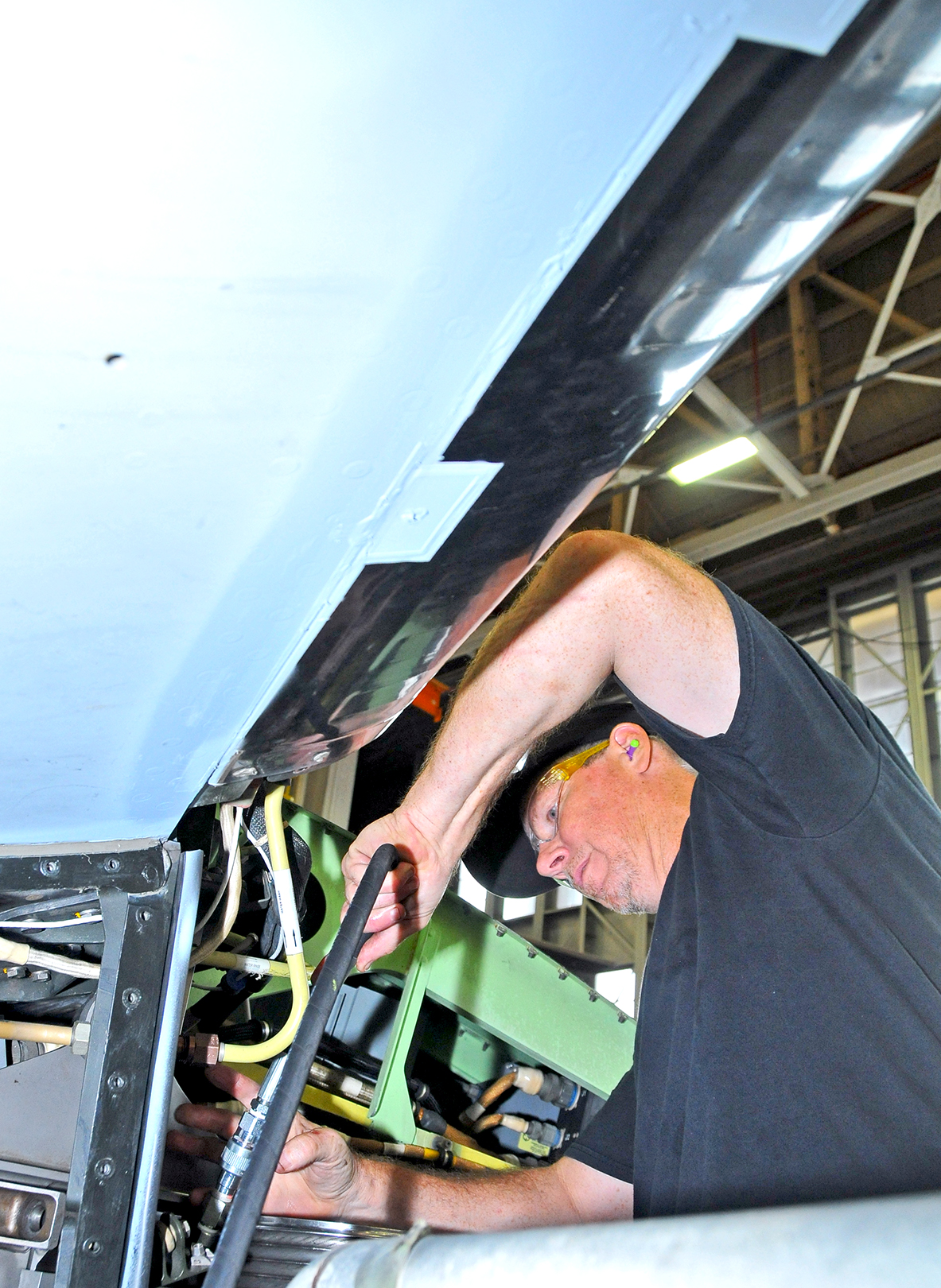
Tommy Ward, V-22 aircraft mechanic, attaches a hose from the V-22 Wing Lift Kit to an actuator port during an on-the-job training session Aug. 9 at Fleet Readiness Center East.(U.S. Navy Photo Released/Chrystal Smith)
OJT: Op teaches use of new kit while accomplishing needed repair on V-22
MARINE CORPS AIR STATION CHERRY POINT, N.C. — A V-22 in-process at Fleet Readiness Center East needing work performed under its wing gave several FRC mechanics from the East Coast a special on-the-job training opportunity Aug. 7-11.
The need to replace the wing stow bearing surfaces, or sliders, located just under the wing, opened a window for training with the new V-22 Wing Lift Kit from Boeing that ensured about 13 more artisans, fleet support representatives and V-22 fleet support team engineers became proficient at the task.
"It’s not just training. It’s OJT," said David Beaman, FRC East V-22 FST engineer, explaining that removal and replacement of the sliders on the aircraft would be accomplished during training on how to use the kit to lift the wing and perform the procedure.
According to Beaman, the training session was an opportunity of advantage for the artisans and the original equipment manufacturers from Boeing.
"It gives artisans an opportunity to ask Boeing questions and learn more details about the system," said Beaman. "It’s a chance to solidify the procedure with the artisans. The opportunity gives the artisans a chance to get more understanding of the slider replacement procedure and why we’re doing it."
David Scheerer, Boeing Wing Stow Systems engineer, and John Werkley, of the Fast Response Group Training Team, led the training for FRCs on the East Coast to teach the wing lift procedure using the recently released kit. The two facilitated a session of training on the West Coast for FRCs at Camp Pendleton in July.
The wing lift kit started as a working prototype in 2010, and was in a perpetual redesign phase until recently. Artisans, V-22 FST engineers, Boeing and others contributed to this design evolution.
Scheerer referenced an aircraft incident at Kirkland Air Force Base, New Mexico as one instance that brought to light the problem that the slider bearing surfaces — designed to last a lifetime — were wearing out on the aircraft and preventing the stowing of its wing.
The nature of recent deployments introduced dirt, debris and soils as build up on the sliders, said Scheerer.
He explained that initially the aircraft, which has been in operation since the early 90s, was usually stationed at a home base where there was no need to stow the wings. When deployments ramped up in the mid-2000s, deployed aircraft were being stowed on carriers to preserve space and were seeing action in sandy and dusty places such as Iraq and Afghanistan. Over time, accumulation of the soiling elements occurred and the buildup was causing the sliders to fail.
"Shipboard space is critical when operations are ongoing," said Scheerer.
At first slider replacement was made by completely removing the wing. That procedure to remove and replace the 12, 4.5-inch sliders took about six months to complete. Boeing engineers worked with V-22 FST engineer Ted Beszterczei to devise a procedure to shortcut the process.
The depot-level process quickly changed to only lifting the wing one inch and reduced the turnaround time for such a repair to less than a week. However, every time the task needed to be completed, a Temporary Engineering Instruction had to be issued. Also through the years the equipment or kit to accomplish the procedure was in continual evolution.
Now that the kit is ready and lessons learned during the course have been integrated, the procedure will be incorporated in the V-22 Interactive Electronic Technical Manuals, or IETM.
Beaman credited the success of the East Coast training to the cooperative efforts of Scheerer and Werkley, and FRC East V-22 Integrated product team lead, supervisors, artisans, FST engineers and FSR.
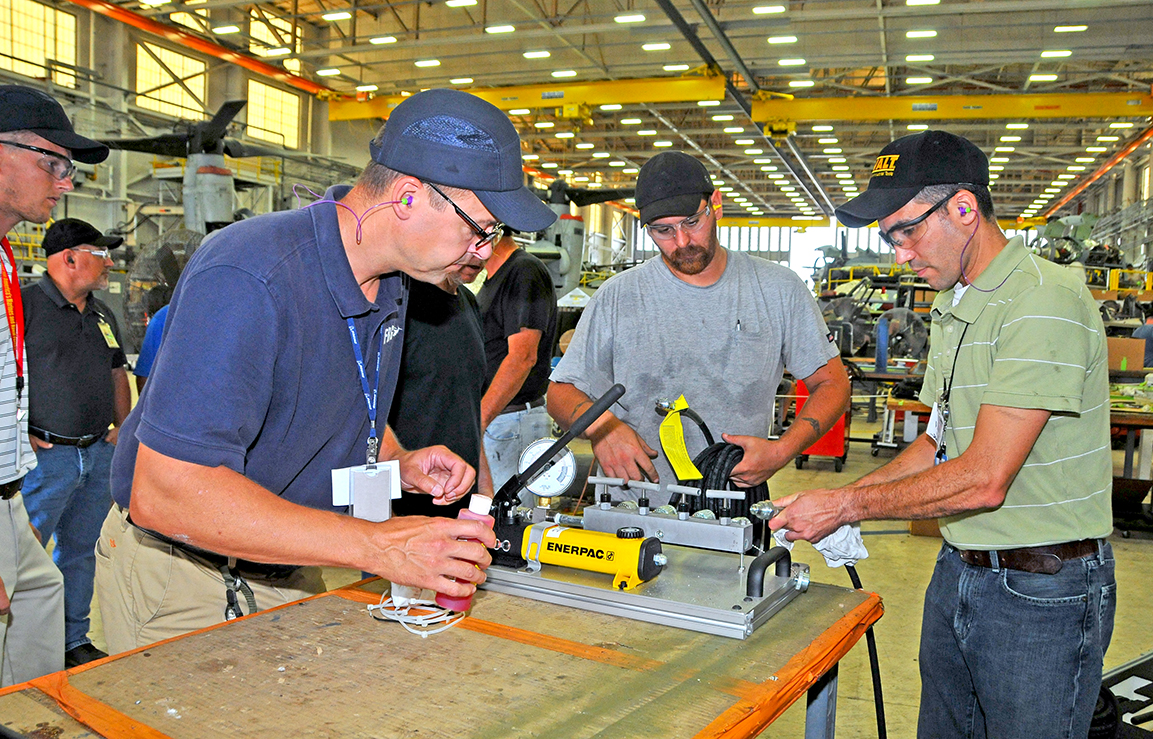
John Werkley, of the Fast Response Group Training Team, and David Sheerer (right), Boeing Wing Stow Systems engineer, set up the V-22 Wing Lift Kit to begin the procedure of lifting the wing during an on-the-job training session Aug. 9 at Fleet Readiness Center East.(U.S. Navy Photo/Released Chrystal Smith)