




FLEET READINESS CENTER EAST~ Service to the Fleet ~Since 1943, Fleet Readiness Center East aboard Marine Corps Air Station Cherry Point, North Carolina, has played an important part in national defense. Our workforce has earned a reputation of excellence in providing world-class maintenance, engineering and logistics support for Navy and Marine Corps aviation, as well as other armed services, federal agencies and foreign governments. Our skilled workforce uses state-of-the-art technology to ensure that FRCE is without equal in providing quality, cost-effective support. Our employees take great pride in their work, and this professional spirit is evident in the high-quality products they produce. |
|---|
Our mission is to maintain and operate facilities and perform a complete range of depot level rework operations on designated weapon systems, accessories, and equipment; manufacture parts and assemblies as required; provide engineering services in the development of changes of hardware design; furnish technical services on aircraft maintenance and logistic problems; and perform, upon specific request or assignment, other levels of aircraft maintenance. |
FLEET READINESS CENTER EAST~ Service to the Fleet ~Since 1943, Fleet Readiness Center East aboard Marine Corps Air Station Cherry Point, North Carolina, has played an important part in national defense. Our workforce has earned a reputation of excellence in providing world-class maintenance, engineering and logistics support for Navy and Marine Corps aviation, as well as other armed services, federal agencies and foreign governments. Our skilled workforce uses state-of-the-art technology to ensure that FRCE is without equal in providing quality, cost-effective support. Our employees take great pride in their work, and this professional spirit is evident in the high-quality products they produce. |
|---|
Our mission is to maintain and operate facilities and perform a complete range of depot level rework operations on designated weapon systems, accessories, and equipment; manufacture parts and assemblies as required; provide engineering services in the development of changes of hardware design; furnish technical services on aircraft maintenance and logistic problems; and perform, upon specific request or assignment, other levels of aircraft maintenance. |
Jul 28, 2026
FRCE conducts first on-site HH-60W Jolly Green II repair
An unplanned repair on an Air Force search-and-rescue helicopter is providing Fleet Readiness Center East (FRCE) with the opportunity to refine its HH-60W maintenance skills before the depot begins planned maintenance on the aircraft platform later this year.
While FRCE is slated to begin inducting HH-60W Jolly Green II aircraft for depot-level maintenance overhauls in September at its new facility at the North Carolina Global TransPark in Kinston, this unexpected in-service repair is serving as a strategic training ground for the depot-level maintenance team, providing an invaluable head start on readying its facilities for the workload.
FRCE Commanding Officer Capt. Randy Berti said the event showcases the depot’s dedication to supporting the warfighter and flight line readiness.
“This is an important step in our greater expansion in support of the warfighter and a massive win for our workforce,” Berti said. “This shows that our artisans will stop at nothing to give the fleet the support they need when they need it, even though our dedicated facility is not yet fully operational.”
As the first maintenance event of its kind to be performed at FRCE’s existing H-1 facility at the Global TransPark in Kinston, this in-service repair is giving artisans beneficial experience that will enable the team to easily transition to supporting the new workload later this year, said Rotary Wing Division Director Andrew Rock.
“By taking on this repair now, we are gaining essential knowledge of the platform's systems that can’t be taught in a classroom,” Rock said. “It allows us to establish our workflows and refine processes well before we begin inducting aircraft for scheduled, depot-level maintenance.”
FRCE was selected as the stateside depot source of repair for the HH-60W Jolly Green II in 2023. FRCE will conduct all airframe programmed depot maintenance for Jolly Green II aircraft located within the continental United States, which represents about 70% of the platform’s total expected workload.
Unlike routine, scheduled maintenance, this aircraft arrived at FRCE as an in-service repair – an unscheduled, targeted repair request triggered by a specific fleet issue. These specialized repairs require depot-level expertise because the damage falls beyond the scope of standard squadron- or intermediate-level maintenance.
This in-service repair is being performed by members of the depot’s current H-1 aircraft line, who will transition to supporting the HH-60W full-time later this year. The team has been training alongside operational Air Force maintenance squadrons since 2024 to become more familiar with the platform’s maintenance activities, according to HH-60W Branch Head Travis Beamon.
“Working side-by-side with active-duty units allowed us to learn a lot,” said Beamon. “It gave us opportunities to perform flight control rigging, landing gear inspections, and main rotor head and transmission inspections – all the things we needed to master by September. That training, combined with this current repair, has given our team the qualifications we need for inductions.”
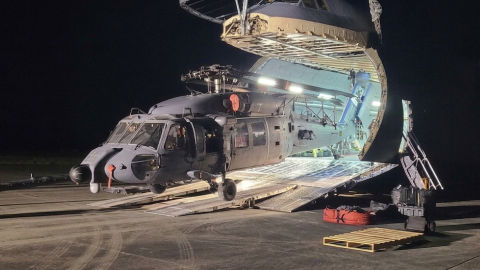
For this specific event, the helicopter arrived at the Kinston facility via a C-5M Super Galaxy – the largest military transport aircraft in the U.S. Air Force designed to transport oversized cargo. Ahead of its arrival, the FRCE team traveled to Nellis Air Force Base, Nevada, to undergo specialized aircraft loading and unloading training with the squadron.
“Whenever you load an aircraft onto a C-5, it’s called uploading,” said Beamon. “It involves very specific events, such as folding the blades, because they aren’t automated functions like some other aircraft. Artisans had to learn how to manually fold the blades and prepare the aircraft to fit into a C-5, in addition to learning how to put it back together once it’s taken out of a C-5.
“This was an important learning opportunity for our artisans,” Beamon continued. “Many of our HH-60W inductions that are set to take place when our new facility opens up will come in on a C-5 and may even go back to the unit on a C-5, so it’s very important for our artisans to be knowledgeable of the processes and feel comfortable uploading and downloading these aircraft.”
While this is the depot's first HH-60W repair on FRCE property, it is not the team's first experience with the platform. Earlier this year, FRCE artisans traveled to Kirtland Air Force Base, New Mexico, to complete their first in-service repair alongside the local rescue squadron. Beamon said the knowledge and experience gained during that initial repair event will allow the team to repair and return aircraft to the fleet faster.
“Even though our current repair is more involved, it builds directly on the training and experience we gained during our first in-service repair at Kirtland Air Force Base,” Beamon said. “Because we are repeating several of the same high-level repairs and inspections we’ve already done before, we’re hoping to expedite this turnaround time so we can get it back to the Air Force quickly.
“These aircraft are used for combat search and rescue, and since they are a newer platform, there are still a lot of HH-60Ws being delivered to the units,” Beamon continued. “In order to maintain readiness of the fleet, it’s very important that we get this aircraft back as soon as possible.”
In addition to building technical skills, the event allows the depot to identify and source any additional support equipment and specialized tooling required to support the platform. Beamon said this opportunity will enable a more seamless adoption of the workload.
“Being able to go out and work with the maintenance squadrons, in addition to bringing an aircraft here to use our tools for the repair, we’re able to easily identify the support equipment commonly used on this aircraft,” Beamon said. “It allowed us to see their specialized and locally manufactured tooling to help us understand what types of equipment we need at our facility. That way we have everything we need for inductions in September.”
Jul 14, 2026
FRCE slashes bracket manufacture time to meet urgent fleet need
When Marine Corps Air Station New River-based Marine Heavy Helicopter Squadron 461 (HMH-461) experienced a critical need for CH-53K King Stallion parts while conducting training in Arizona, Fleet Readiness Center East (FRCE) filled the requirement within hours, returning the aircraft to mission-capable status at breakneck speed.
HMH-461 needed support brackets for a heat exchanger unit onboard a CH-53K heavy-lift helicopter, and they needed them quickly: The squadron, supporting a high-visibility tasking, was slated to return to New River less than two weeks later. The parts were unavailable through traditional supply methods, and the initial estimate for organic manufacturing at FRCE came in with an eight- to 10-week lead time – far too long for the aircraft to be grounded and still meet the squadron’s operational requirements.
In the end, a cross-disciplinary team at FRCE was able to condense a weeks-long process into just over 37 hours, and a depot in-service repair (ISR) team was dispatched to Marine Corps Air Station Yuma, Arizona, with parts in hand only five days after FRCE received the initial request. When a second aircraft experienced the same requirement days later, FRCE was able to reduce manufacturing time on a third bracket to an unheard-of 12 hours and overnight the part to Yuma for installation by the ISR team already there on the ground.
“This successful endeavor reinforces what our customers know to be true: FRC East is here to take care of the warfighter, and we’ll go to any lengths to make that happen,” said FRCE Commanding Officer Capt. Randy J. Berti. “When called upon by the squadron, our people were able to condense a manufacturing effort from weeks into mere hours, then send a team with parts in hand to complete a much-needed repair that returned a mission-ready aircraft to the Marine Corps. It sounds incredible because it is incredible … but it’s also what our people do day-in and day-out in service to the fleet.”
FRCE Military Production Officer Cmdr. John Vincent said the effort took a tremendous, collaborative push from disciplines across the command – machinists, engineers, quality analysts, aircraft maintainers and more – but is an excellent representation of FRCE’s dedication to supporting Naval aviation.
“We understood the urgency, and when the fleet has a need that affects mission readiness, FRC East is thoroughly capably of responding,” he explained. “This was not a standard processing time – this was a Herculean effort we put together. All the pieces fell into place in a perfect scenario, but the truncated timeline wouldn’t have been possible without the expertise and commitment of the individuals pushing this project forward to make it happen so quickly. Our people do amazing things, and each one of the leaders along the way knew the importance of what we were doing.
“Demonstrating that FRC East is able to rapidly manufacture these parts will definitely help enable fleet readiness, because now the task is easy: just replace the bracket,” Vincent continued. “The ability for the enterprise to manufacture these parts removes the question of where the part can be obtained and makes it a matter of simply completing the repair rather than sourcing the materiel.”
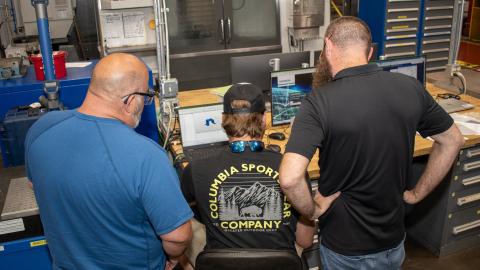
The inboard utility heat exchanger on the King Stallion is secured by four brackets; FRCE manufactured two of the brackets for the first time earlier this year, with the initial run taking about 30 days due to technical requirements. FRCE obtained technical data packages for the parts and a team in the depot’s Digital Data Center converted the data into digital models and programs that guide computer numerical control (CNC) machining equipment in cutting the brackets from blocks of solid metal. Meanwhile, the materials engineering lab verified the composition and physical properties of the metal being used to manufacture the parts. With those foundations in place, the command’s organic manufacturing team was able to complete the machining process, and the finished brackets went forward for quality assurance verification, nondestructive testing, cleaning and anodizing before being shipped to the squadron.
The successful first round of manufacturing the heat exchanger brackets set the stage for the rapid turnaround time achieved for HMH-461’s request from Yuma, said Russ Becker, the manufacturing planning supervisor in FRCE’s Centralized Coordination Department.
“The long lead times on the first run were driven by first-time manufacture requirements; what truly made this latest effort a spectacular success were the building blocks put into place the first time through,” Becker said. “Provided with an executable plan and the tools and data they needed to perform, our talented and dedicated team of artisans was able to provide the fleet with the assets needed to get the aircraft back to mission-ready status in unmatched time. The fleet had an urgent requirement and, in keeping with our ‘Service to the Fleet’ mandate, FRC East responded.”
After receiving HMH-461’s urgent request and manufacturing two heat exchanger brackets at incredible speed, cutting the process from more than 30 days to just over three, FRCE received the follow-on request for the third bracket. This time, the part reached completion in about 12 hours – reducing the previous manufacturing timeline for that part by almost two-thirds.
According to Clifton Force, head of FRCE’s Field Team and In-Service Repair Planning shops, the undertaking represented a massive win for the enterprise.
“This was a great example of our teams coming together to support the fleet,” he noted. “The incredible turnaround in manufacturing the first set of brackets allowed our in-service repair team to fly out with the parts in hand. When the need for the third bracket was identified, the manufacturing team produced it almost immediately, ensuring no momentum was lost in this expedited repair effort. The overall effort by FRC East ensured both aircraft could be returned to a mission-capable status so the squadron could return to New River on schedule – that’s a real-world operational impact.”
Maj. Clayton Cottrell, the MHM-461 maintenance officer, agreed that the support provided by FRCE made a tangible difference in the squadron’s ability to complete the mission.
“During high-tempo operations like Weapons and Tactics Instructor Course 2-26, aircraft availability is critical to achieving our training objectives and maintaining our combat readiness,” he explained. “When we faced a sudden, non-mission-capable status due to unavailable brackets, the traditional supply chain process couldn't source the required parts in an acceptable timeline.
“The speed and adaptability demonstrated by the Fleet Readiness Center East team was outstanding, directly facilitating continued advanced tactical training at WTI,” he continued. “By compressing a weeks-long manufacturing process into a much shorter timeline and deploying an In-Service Repair team directly to the flight line in Yuma, FRCE’s timely effort kept our aircraft in the fight, ensured our pilots and aircrew completed their training at WTI, and allowed the squadron to redeploy back to New River on schedule. We are incredibly grateful for FRCE’s support.”
Jun 29, 2026
FRCE partners with Reservists, Marines for joint readiness training
Imagine a military aircraft sustaining heavy structural damage in a remote, forward-deployed combat location. If the repairs are outside the scope of standard squadron-level maintenance and shipping the aircraft to a depot is not an option, how does the fleet rapidly repair and return that critical asset to the fight?
This high-stakes question drove Fleet Readiness Center East (FRCE) to host the command’s second annual forward-deployed combat repair training exercise May 18-22. The exercise was designed to sharpen skills and increase readiness of the Naval Air Systems Command (NAVAIR) Forward Deployed Combat Repair (FDCR) Team, an elite group of Navy Reservists and skilled depot-level artisans, engineers and planners and estimators who deploy worldwide – afloat and ashore – to rapidly repair and return battle-damaged aircraft to the fleet.
This five-day training evolution embedded the participants into a scenario designed to mirror conditions the team is likely to encounter if deployed in support of the warfighter. With a goal of increasing operational readiness, the event allowed FRCE artisans, Navy Reservists and Marines to build working relationships, gain experience with real-world deployment challenges, and enhance aircraft maintenance and repair capabilities.
FRCE Commanding Officer Capt. Randy Berti said training exercises like this are essential to maintaining fleet readiness and maximizing lethality.
“Providing artisans and service members with this invaluable training opportunity is exactly how we sustain the world’s most lethal fighting force,” said Berti. “No mission goes exactly according to script, and every minute an aircraft spends on the ground during a mission carries a massive cost. That is why this immersive experience is so important. It forces the team to troubleshoot complex repairs while under pressure now – laying that foundation – so they aren’t facing high-stakes challenges for the first time in the field when it matters most.”
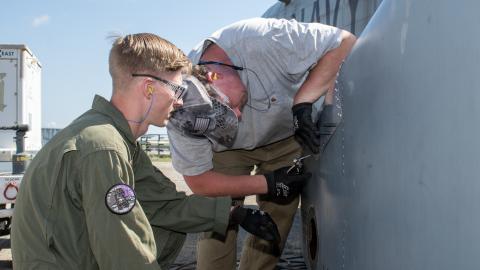
FRCE supported the training event with aircraft and a cross-disciplinary team of engineers, planners and estimators and artisans who are assigned to the FDCR mission to work alongside the service members and execute repairs.
While repairs may be performed by squadron personnel, aircraft battle damage repairs often require specialized repair and damage analysis, skills and tools from depot-level maintainers. The exercise was a great opportunity for the depot-level artisans and engineers and service members to learn from each other, said Navy Capt. Jim Mcdonnell, a Reservist on the NAVAIR FDCR Team.
“FRC East’s artisans are the experts; they’ve been doing this for years,” said Mcdonnell. “The intermediate- and organizational-levels don’t necessarily have all the capabilities that FRC East can bring. The Marines had some of this type of training in A School, but they don’t get to practice it. The level of repair that they did here allowed them to sharpen their skills. They really enjoyed being able to learn battle damage repair from a skilled artisan, which is especially helpful because tricks of the trade aren’t easily taught in school. It was a great opportunity for us to develop our skill sets for when we are deployed.”
During the exercise, the 52 participants were split into three teams. Each team navigated a distinct hypothetical deployment scenario and was responsible for repairing an aircraft – either an MV-22B Osprey or CH-53E Super Stallion – with simulated battle damage.
Just like a deployment, the team’s resources were extremely limited during the exercise. Artisans and engineers only had the minimal tooling they were able to bring, if any, and the equipment that would normally be present in a deployed environment to complete the repairs. This can be especially challenging as they don’t always know what needs repairing until they arrive, according to Field Team Shop Supervisor Clifton Force, who oversees the depot’s FDCR Team.
“Oftentimes, these guys don’t know what they are going to be dealing with until they get there,” said Force. “They have to be adaptable and extremely resourceful because their FDCR kit may be the only source of tooling they have to fix complex damages. They have to look at what they have, look at what’s broken and figure out a way to make it work to get the aircraft back in the air.”
Building onto the foundation of last year’s iteration, this year’s team was larger, allowing them to tackle more repairs and test new, advanced repair technologies, said Mcdonnell.
“Not only are we getting more people trained, but we are doing more repairs on more aircraft,” Mcdonnell said. “Marine Aviation Logistics Squadron 14 and 26 sent out aircraft maintainers from their intermediate-level maintenance facilities to support the exercise. We also incorporated fiber optic repairs to evaluate possible tooling and prototypes the team can use to repair fiber optic cables in the field. All three of these built onto our overall capability, allowing us to be more prepared for when we need it.”
By putting their skills to the test in a high-pressure, simulated combat environment, the participants walked away with far more than just practice – they left with a proven capability to sustain the fleet anywhere in the world, Force said.
“At the end of the day, our goal here was to increase readiness and we did exactly that,” Force said. “Not only are the artisans, engineers and planners from FRC East more prepared to support the warfighter, but so are the Reservists and Marines.”

Jun 3, 2026
FRCE legacy of Harrier support spans 50 years
An era has officially come to an end. Now that the Marine Corps has officially retired the AV-8B Harrier II, let’s look back at Fleet Readiness Center East’s 50-year legacy of supporting the platform that revolutionized military aviation.
It all began in 1973. Fleet Readiness Center East (FRCE) was assigned the AV-8A Harrier and F402 engine workload, and the depot inducted its first AV-8A Harrier in 1974. At the time, FRCE was the only rework center in the United States for the Marine Corps’ premier vertical takeoff and landing aircraft. Because the platform was so new, much of the maintenance tooling and equipment was designed and manufactured here, and numerous rework and repair procedures for the platform were researched, planned and implemented at FRCE.
Generations of artisans spent their careers watching this platform evolve – from the original AV-8A to the highly advanced, radar-equipped AV-8B Harrier II Plus. Countless hours of hard work and unwavering dedication went into supporting the AV-8, all driven by a single mission: keeping the fleet ready.
After decades of providing world-class maintenance, repair and overhaul services for the legendary jump jet, our team delivered its final Harrier and F402 engine to the fleet in 2024. While bittersweet, this historic effort set the standard of excellence that now fuels the next generation of vertical-lift aircraft.
While their flying days have come to an end, their legacy lives on. We will never forget the incredible skill of the workforce who kept them flying, the roar of the engines on the flight line, and the pride of supporting the Marines who flew them.


